Why choose Floriverse as your specialist wholesaler?
1. Complete short circuit – from the field to your plot
At Floriverse, Ipheion, Inca Garlic bulbs are grown and packaged by our own horticultural partners, without any middlemen. You benefit from stable producer prices and rigorous quality control on each batch (size, health, uniformity).
2. B2B logistics calibrated for professionals
-
Real-time availability: daily stock updates; in a sector where supply is limited, it is advisable to reserve your varieties 3 to 6 months in advance to guarantee varietal choice.
-
Express preparation: during the season, delivery within 7 to 15 days throughout France and Europe. Outside Europe is possible upon request.
-
Optimized packaging: packaging varies according to the volume ordered; we select the most protective solution for the health of the bulbs while guaranteeing the best optimization of logistics costs.
-
Delivery: France delivered within 7 days, Europe within 15 days; for destinations outside Europe, we prepare a tailor-made offer. Incoterms DAP or FCA of your choice.
-
Proactive monitoring: real-time tracking by our teams.
3. Horticultural expertise
Founded in 2024 by plant enthusiasts, Floriverse offers its expertise in flower bulb cultivation to professional florists. Our technical team advises you on:
- the choice of planting calendars (open field / greenhouse forcing),
- optimal densities to maximize the rate of marketable stems,
- integrated management of pests and sustainable fertilization.
4. Guarantees & customer reviews
-
Google Rating: 5/5
Responsiveness, speed and product quality are the most cited points.
Recent customer excerpts
“The plants are of high quality, extremely careful delivery.” — S. Aubailly (May 2025)
“Responsiveness, professionalism, good price.” — A. Benedetto (Feb. 2025)
“Superb blackcurrant plants, accommodating service.” — F. Laurent (March 2025)
“Responsiveness, friendliness and top-notch products.” — E. Fleurat (Jan. 2025)
“Professional advice, fast delivery, impeccable quality.” — V. Morales (Nov. 2024)
“Unbeatable prices and impeccable customer service.” — AC (Dec. 2024)
How to order from Floriverse?
Request your personalized quote now – response within 48 hours for a batch of Ipheion bulbs, Garlic of the Incas :
We open your wholesale account in less than 24 hours, with no activation fees, and provide a customized quote based on your volumes.
Professional applications of Ipheion uniflorum
Ipheion uniflorum stands out for its versatility and its ability to integrate harmoniously into various landscaping and production systems, offering considerable advantages for professionals in the sector.
Landscape integration and naturalization
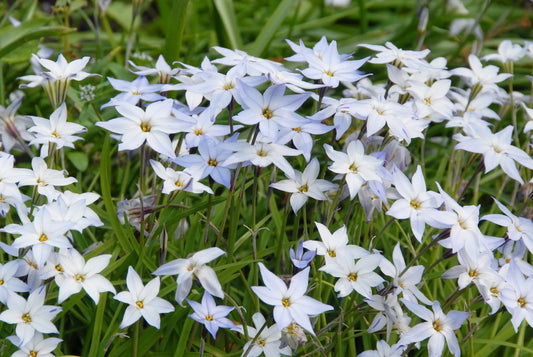
Ipheion is ideal for creating natural, long-lasting scenes. It fits perfectly into flowerbeds, where its low, ground-hugging habit quickly creates vast expanses of flowers. Its star-shaped flowers, ranging in color from pure white to periwinkle blue, sometimes lilac or pink depending on the cultivar, bring a touch of freshness and light from the end of winter, a period when few other blooms are present.
For borders, its moderate height (usually 15 to 20 cm ) makes it a plant of choice for delineating paths and flowerbeds, offering a constant decorative effect. In rockeries and slopes, Ipheion excels thanks to its tolerance of less rich soils and its imperative need for drainage, tolerating both full sun and light shade.
A major asset of Ipheion is its remarkable ability to naturalize. The initial bulb produces numerous bulblets that develop rapidly, allowing the plant to spread over several square meters in just two to three seasons , creating dense carpets of flowers. In suitable soils, it can even become "sometimes invasive," a sign of its great longevity and self-sufficiency in place, which makes it an excellent ground cover for semi-natural or low-maintenance spaces. For extensive plantings, a density of 80 to 100 bulbs per square meter is recommended to obtain a rapid and uniform ground cover effect.
Applications for communities and large public spaces
For town halls, green space departments, and large estate managers, Ipheion uniflorum represents a strategic investment. Its exceptionally long flowering period, extending over 2 to 3 months (from February-March to May), and which can begin as early as December in mild climates, ensures prolonged and early visual appeal, filling the late winter lull.
The ease of maintenance of Ipheion is a major economic advantage, classified as "Easy", it requires only minimal care, thus optimizing human and financial resources. Its cultural requirements are moderate: it accepts a wide range of soils (acidic, neutral, alkaline), provided they are well drained, and adapts from full sun to partial shade. This versatility makes it suitable for use in naturalized lawns, clumps, at the base of shrubs, or in light undergrowth.
Valorization in cut flowers
Although Ipheion is primarily a garden bulb, it has interesting qualities for cut flowers. Its light and delicate fragrance is appreciated in refined floral arrangements. Its early flowering offers a source of cut flowers outside of the traditional seasonal peaks. The diversity of its colors (light blue, mauve, white) enriches the florist's offering.
However, its main limitation for this use lies in the short length of its stems, which generally measure between 15 and 30 cm , making it more suitable for small bouquets or table arrangements. Its vase life is also relatively short, around 4 to 6 days .
Honey and ecological interest
Ipheion uniflorum actively contributes to the biodiversity of your landscapes. Its early flowering, from March to May, positions it as an essential resource for pollinators as soon as winter ends, a period when floral supply is still limited. It mainly attracts domestic and wild bees (Halictidae, Andrenidae), as well as certain hoverflies and early diurnal butterflies, thanks to its easily accessible nectar and pollen.
It plays a crucial role as a "relay plant" to support pollinating insect populations at the start of the season, contributing to general pollination ( 80% of flowering plants in France depend on pollinating insects).
Additional features
It is important to note that Ipheion has no known toxicity to humans, pets, or livestock. It is also not a protected species under French or European legislation, ensuring unrestricted marketing and cultivation. Furthermore, the leaves and flowers are edible, releasing a garlic or onion flavor when crushed, which may be of marginal culinary interest for certain specialized applications.
Planting techniques and cultivation management
Successful planting of Ipheion is the key to its longevity and abundant flowering.
Seasonal planting schedule
The optimal time to plant Ipheion bulbs in France is from September to November . This window allows the bulbs to develop a robust root system before the arrival of the cold weather, ensuring better vegetative recovery in the spring. Although there is no strictly established soil temperature threshold, it is advisable to plant when the temperature is still above 8-10°C .
Technical parameters of planting
Bulbs should be planted 5 to 10 cm deep, with the tips pointing upwards. For spacing, leave 5 to 10 cm between each bulb. For dense plantings aiming for a rapid ground cover effect, a minimum spacing of 5 cm is suitable, allowing a density of 50 to 75 bulbs per square meter to be achieved. If the objective is a more perennial clump and natural development, a spacing of 10 cm will be more appropriate. It is recommended to plant a minimum of 5 bulbs per group for a striking visual effect.
Substrate preparation and drainage
Ipheion is demanding when it comes to soil drainage, as it absolutely cannot tolerate stagnant moisture. The ideal soil type is sandy loam , which provides a perfect balance between drainage, moisture retention, and structure. The optimal pH is between 6.5 and 7.0 , which is slightly acidic to neutral, although values of 6.0 to 7.0 are acceptable.
If your soil is clayey, deep amendment (at least 30 cm below planting level ) with well-rotted, pH-neutral compost is imperative to improve structure and permeability. For excessively sandy soils, incorporating peat or decomposed organic matter will improve water retention and fertility without compromising drainage. It is crucial to prepare the soil to at least 30 to 40 cm deep to ensure optimal drainage, particularly in heavy soils.
Light exposure management
Ipheion uniflorum is remarkably adaptable, tolerating a variety of light conditions. The optimal exposure is full sun to partial shade, requiring a minimum of six hours of direct sunlight daily for ideal growth, flowering, and development. Full sun exposure is preferred for professional production to promote more abundant flowering and more robust plants.
Irrigation and fertilization program
Ipheion's water requirements are moderate. After planting, keep the soil slightly moist but not soggy, with sufficient weekly watering. During vegetative growth (late winter/early spring), increase watering slightly ( 20-30 mm of water per week ). During flowering, regular watering ( 30-40 mm per week ) helps extend the flowering period. However, the summer dormancy period is critical: watering should be significantly reduced, as excess water can lead to bulb rot.
Regarding fertilization, incorporate well-rotted compost ( 2-3 kg/m² ) or a balanced slow-release fertilizer ( NPK 10-10-10 at 30-40 g/m² ) when preparing the soil. During vegetative growth, a fertilizer rich in nitrogen and potassium ( NPK 10-5-15 at 20-25 g/m² ) is beneficial. Before and during flowering, favor a fertilizer rich in phosphorus and potassium ( NPK 5-10-15 at 20-30 g/m² ) to stimulate flowering and improve flower quality. After flowering, a light application of fertilizer rich in potassium ( NPK 5-5-15 at 15-20 g/m² ) will help the bulb replenish its reserves.
Winter protection and mulching
A 4 to 5 cm thick mulch, applied after the first frosts when the soil begins to harden, is recommended to stabilize soil temperature and prevent alternating freeze/thaw cycles, particularly in regions with harsh winters. Use loose organic materials such as straw, hay or oak leaves. This mulch should be lightened or removed gradually in early spring to avoid hindering the growth of young stems and to limit the risk of rot. Ipheion is hardy to -10°C to -15°C in general, and even -20°C for cultivars such as 'Wisley Blue', making it suitable for most French regions.
Routine maintenance and upkeep
Ipheion is a low-maintenance plant, which is a major advantage for professionals. Weeding must be done carefully to avoid damaging the lower layers of the plant. It is crucial to allow the foliage to yellow naturally after flowering and to only cut it when it is completely dry. This phase allows the bulb to replenish its nutrient reserves, essential for flowering the following year.
Deadheading is not strictly necessary as the plant naturalizes easily; it can be done to control propagation by seed. Dividing clumps every 5 years is recommended to maintain vigor and abundant flowering. This operation is carried out in early summer, when the foliage has yellowed and the plant enters dormancy. The bulbs can remain in the ground from one year to the next and will flower again faithfully.
Crop rotation management
For crop health, it is strongly recommended not to plant Ipheion after or with crops that have received unrotted manure or mushroom compost, or with plants vulnerable to slugs and snails, or requiring abundant summer watering. Ipheion integrates well after crops with similar soil requirements (well-drained, neutral pH) and low summer water needs.
Adaptations to extreme climatic conditions
In case of prolonged drought during its growing season (autumn-spring), keep the soil slightly moist. During summer dormancy, watering can be significantly reduced or stopped, as Ipheion tolerates drought well at this stage. Incorporating peat and aged leaf compost improves water retention in sandy soils. A 3-5 cm mulch in autumn also helps retain moisture.
For very harsh winters, plant the bulbs deeper ( 10-15 cm ) and apply a layer of organic mulch of at least 5 cm . Growing in pots, which can be moved to a cold greenhouse if temperatures drop below -5°C , is an option for areas with extreme winters.
Botanical and varietal characteristics
For a comprehensive understanding of this remarkable plant, here are some additional technical details on Ipheion uniflorum.
Botanical classification and nomenclature
The full scientific name of this plant is Ipheion uniflorum . It is also known by the synonyms Tristagma uniflorum and Triteleia uniflora. As for its botanical family, the classification can vary: some sources attach it to the Liliaceae, others to the Amaryllidaceae (subfamily Allioideae), and the IPNI (Index of International Plant Names) classifies it in the Alliaceae. It is a bulbous plant native to Paraguay and Argentina.
Morphology of the underground system
Ipheion uniflorum has a true tunicate bulb, an underground storage organ protected by a dry, papery envelope. The bulb is small, ovoid or ellipsoidal in shape, typically measuring between 1.5 and 2.5 cm in diameter at maturity. Its tunic is brown to light beige in color, which can be silvery or golden. The interior of the bulb is whitish and firm. The bulbs are often grouped in "strings" with a main bulb and several secondary bulbils, and are easily propagated by division. Notably, these bulbs are resistant to rodents and deer.
Description of the leaf system
The foliage of Ipheion is linear and semi-erect, reminiscent of blades of grass. The leaves are narrow, 10 to 20 cm long and 2 to 4 mm wide. They have a fine and supple texture, and give off a characteristic odor of onion or garlic when crushed, a distinctive feature of the genus. The color of the foliage is a pure green to medium green, without variegation. The foliage is deciduous; it appears in late winter or early spring, persists during flowering (March to May) then turns yellow and disappears naturally in late spring or early summer, an effective presence of 3 to 4 months .
Floral characteristics
The flowers of Ipheion uniflorum are distinctly star-shaped, composed of 6 symmetrically arranged tepals (petals/rays). The diameter of individual flowers is about 3 to 4 cm . They are borne on slender flower stems measuring 7 to 15 cm in height . The dominant color varies from pure white to pale blue, lavender blue, purplish blue, and even deep periwinkle blue, with horticultural cultivars offering pink or purple hues. Each tepal often has a darker midrib. The flowers are fragrant, giving off a spicy or slightly sweet scent. They are usually solitary on each stem, although it is rare to find two.
Vegetative development
At maturity, Ipheion uniflorum reaches an average height of 20 cm , with flower stems of 10 to 15 cm . The width of the clump is approximately 10 cm . Its growth habit is described as "spiky" and it forms a vigorous clump.
Biological cycle and sustainability
Ipheion is a perennial bulbous plant, meaning it lives and flowers for several consecutive years without requiring annual replanting. After flowering, the plant goes into summer dormancy, with the bulb remaining dormant underground. The bulbs multiply spontaneously and quickly in place, allowing the clump to expand. A well-established bulb can live and flower for at least 5 to 10 years , or even longer, under favorable conditions.
Multiplication strategies
The preferred propagation of Ipheion is vegetative, by division of the bulbs. Each year, a mature bulb can produce 1 to 3 new bulbils , which can be replanted. A replanted bulbil generally takes 1 to 2 years to reach flowering size. Propagation by seed is possible but less common for professionals, as it is slower and less reliable for varietal fidelity; plants from seed take 2 to 4 years to flower. For professional production, division is the preferred method for its speed and reliability.
Varietal selection and commercial optimization
The species Ipheion uniflorum is the origin of the majority of popular cultivars, offering a diversity of colors and characteristics:
-
'Alberto Castillo' : Pure white flowers, larger than the type, height 15 to 20 cm, abundant flowering from March to April, excellent hardiness.
-
'Rolf Fiedler' : Deep, intense blue flowers, 15 to 20 cm high, slightly later flowering (April), fragrant.
-
'Jessie' : An even darker and more intense blue than 'Rolf Fiedler', similar height (15-20 cm), flowering in April, appreciated for the intensity of its color.
-
'Tessa' : Unique in its dark pink color with a darker center, height of approximately 15 cm, spring flowering, more recent selection.
Productive performances in culture
Ipheion uniflorum is a very productive variety, capable of forming large flower carpets. Although precise figures on the number of flower stems per bulb or per m² are not provided, its description as "very productive" and forming "large carpets, flowering for a very long time" indicates a high yield. The ability of a 4/+ cm bulb to produce 2 to 3 new bulbs per year ensures rapid expansion of the crop. For rapid coverage, a density of 80 to 100 bulbs/m² is recommended.
Potential for forcing and soilless cultivation
Forcing Ipheion in a greenhouse or indoors is potentially feasible, particularly due to its tolerance to dry storage and its good pot culture. However, there are no established forcing protocols as for other bulbs. Trials are necessary, providing pre-chilling (vernalization) of 8 to 10°C for 6 to 8 weeks to induce off-season flowering. It is crucial to use a very well-draining substrate and to manage watering sparingly to avoid bulb rot.
Health diagnosis and phytosanitary management
A healthy Ipheion bulb should be firm, with no soft or discolored parts, and 1 to 2 cm in diameter . The healthy foliage is ribbon-like green, 20 to 30 cm long , and several flower stems 10 to 15 cm tall are produced per bulb. Flowering lasts about 8 weeks , from March to April.
Stress and deficiency indicators
Signs of water stress include wilted foliage (underwatering) or premature yellowing (overwatering, risk of bulb rot). Deficiencies are manifested by pale foliage (nitrogen), purplish discoloration (phosphorus), or yellowing edges (potassium). Diseases can cause bulb rot (soft texture, unpleasant odor), fusarium wilt (progressive yellowing of leaves), or viruses (deformation, mottling).
After flowering, natural yellowing of the foliage in summer is normal and should not be confused with a problem. In autumn, a healthy bulb will produce a dense clump of leaves. Reduced or absent flowering may indicate stress.
Renewal and influence of the caliber
In professional cultivation, division of the clumps every 3 to 4 years is recommended to maintain vigor and optimal flowering density. This operation helps control overpopulation and regenerate the plants. The size of the bulbs has a direct influence on vigor and flowering: the standard professional size is 4/+ cm , ensuring abundant flowering from the first year. A larger size ( 5/+ cm ) will produce denser flowering and more vigorous plants, while bulbs smaller than 4 cm will produce reduced flowering and will require more time to reach maturity.
To summarize: Our Ipheion uniflorum bulbs
The Ipheion uniflorum bulbs offered by Floriverse are specifically adapted to the requirements of horticulture and cut flower professionals. This species, prized for its starry late-winter blooms and its adaptation to well-drained soils, is an ideal solution for economical, aesthetic, and high-value production. Thanks to its rapid naturalization capacity, Ipheion develops over several square meters in just a few seasons, with a rapid ground cover effect from a density of 80 to 100 bulbs per m². As a specialist wholesale supplier of Ipheion uniflorum bulbs , we rigorously select our batches to ensure a professional size (4/+ cm) and a high recovery rate. You can buy Ipheion uniflorum bulbs with complete confidence thanks to our optimized logistics and technical expertise. Whether for public spaces, flower borders, rockeries, or small floral arrangements, Ipheion meets a wide variety of projects. At Floriverse , our ambition is to offer floriculturists reliable, sustainable products adapted to their constraints. Our bulbs come from specialized crops, are untreated, resistant to deer and have no known toxicity. As a specialist wholesale supplier of Ipheion uniflorum bulbs , we guarantee personalized support for each customer. With their flowering from February to May, their light fragrance, and their compatibility with cut flowers, Ipheion bulbs provide a strategic complement to traditional crops. Buying Ipheion uniflorum bulbs allows us to anticipate market needs with a reliable and aesthetic product. Thanks to our logistics network, our customers can buy Ipheion uniflorum bulbs safely, anywhere in France. In conclusion, Floriverse remains your specialist wholesale supplier of Ipheion uniflorum bulbs , dedicated to the success of your plantations. Our team remains available to guide you, from the choice of product to its cultivation.