Why choose Floriverse as your specialist wholesaler?
1. Complete short circuit – from the field to your plot
At Floriverse, our lily bulbs are grown and packaged by our own horticultural partners, with no middlemen involved. This means you benefit from stable producer prices and rigorous quality control on each batch (size, health, consistency).
2. B2B logistics calibrated for professionals
-
Real-time availability: daily stock updates; in a sector where supply is limited, it is advisable to reserve your varieties 3 to 6 months in advance to guarantee varietal choice.
-
Express preparation: during the season, delivery within 7 to 15 days throughout France and Europe. Outside Europe is possible upon request.
-
Optimized packaging: packaging varies according to the volume ordered; we select the most protective solution for the health of the bulbs while guaranteeing the best optimization of logistics costs.
-
Delivery: France delivered within 7 days, Europe within 15 days; for destinations outside Europe, we prepare a tailor-made offer. Incoterms DAP or FCA of your choice.
-
Proactive monitoring: real-time tracking by our teams.
3. Horticultural expertise
Founded in 2024 by plant enthusiasts, Floriverse offers its expertise in flower bulb cultivation to professional florists. Our technical team advises you on:
- the choice of planting calendars (open field / greenhouse forcing),
- optimal densities to maximize the rate of marketable stems,
- integrated management of pests and sustainable fertilization.
4. Guarantees & customer reviews
-
Google Rating: 5/5
Responsiveness, speed and product quality are the most cited points.
Recent customer excerpts
“The plants are of high quality, extremely careful delivery.” — S. Aubailly (May 2025)
“Responsiveness, professionalism, good price.” — A. Benedetto (Feb. 2025)
“Superb blackcurrant plants, accommodating service.” — F. Laurent (March 2025)
“Responsiveness, friendliness and top-notch products.” — E. Fleurat (Jan. 2025)
“Professional advice, fast delivery, impeccable quality.” — V. Morales (Nov. 2024)
“Unbeatable prices and impeccable customer service.” — AC (Dec. 2024)
How to order from Floriverse?
Request your personalized quote now – response within 48 hours for a batch of Lily / Lilium bulbs:
We open your wholesale account in less than 24 hours, with no activation fees, and provide a customized quote based on your volumes.
Commercial applications and outlets of Lilium
Lilium, with its diversity of species and hybrids, offers a range of professional applications, from cut flowers to landscaping and biodiversity attraction.
Cut flower production: a growth sector
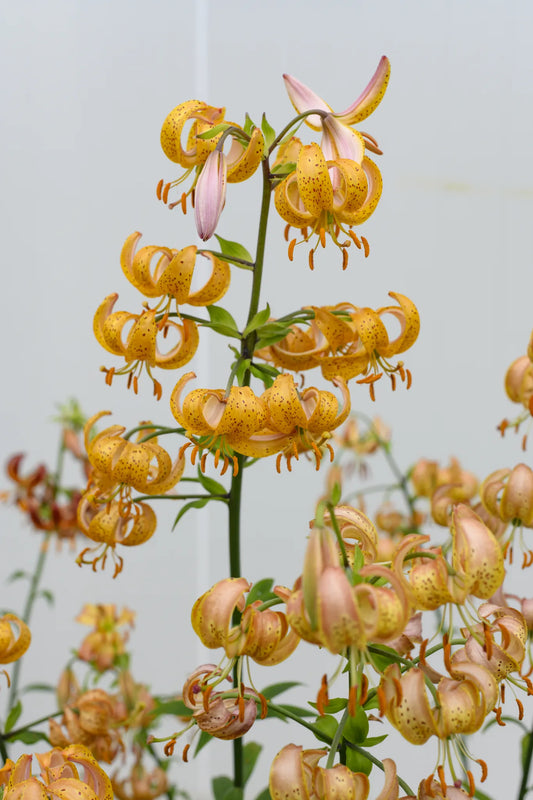
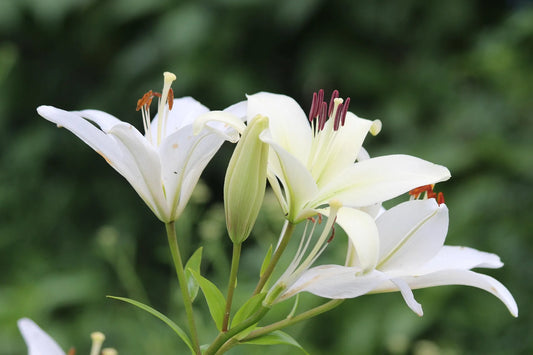
Lilium is a mainstay of the cut flower market, accounting for around 70% of production for some hybrid types. Asian varieties, such as 'Enchantement' (nasturtium red), 'Connecticut King' (yellow), and 'Mont Blanc' (white), are prized for their hardiness and abundant flowering. Oriental Liliums, particularly those derived from Lilium auratum and Lilium speciosum, are highly sought after for their large, cup-shaped flowers and intoxicating fragrance. Lilium longiflorums are distinguished by their long, white flowers, while Lilium speciosum is known for its fragrant pink flowers with red highlights.
Stem quality is intrinsically linked to bulb size; minimum sizes are recommended, for example, a diameter of 12/14 for longiflorum and Asiatic types , and 14/16 for Orientals , to ensure a good number of flowers per stem, superior plant quality and an optimal flowering cycle. For exceptional vase life, it is advisable to cut the stems when the bud is colored, about two days before full opening, ideally in the morning during the coolest hours, and to use a preservative for cut flowers to significantly extend their life. Oriental Liliums, in particular, are valued for their strong fragrance, a major commercial asset.
Professional landscape integration
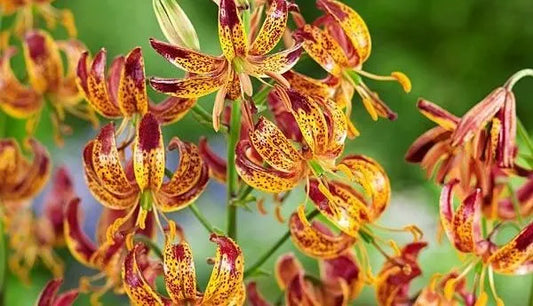
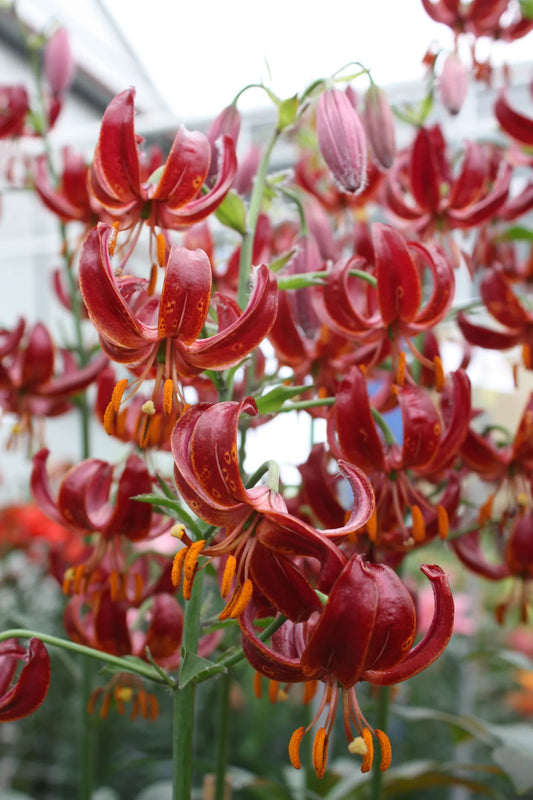
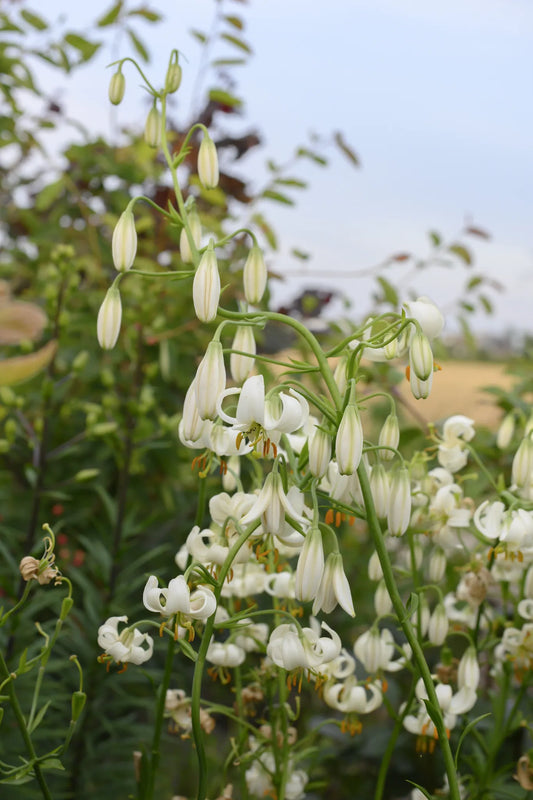
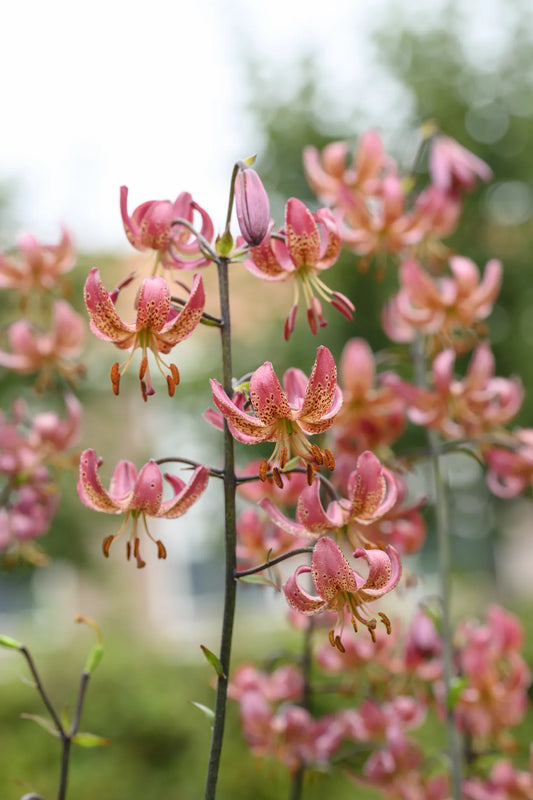
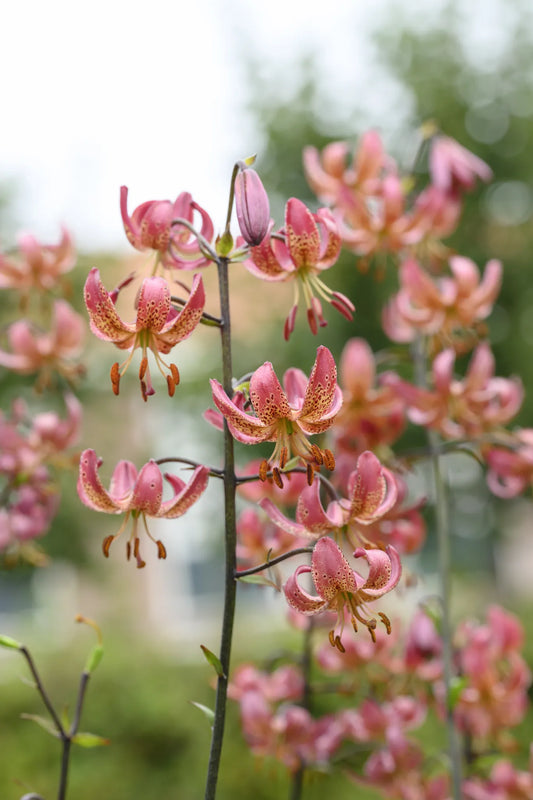
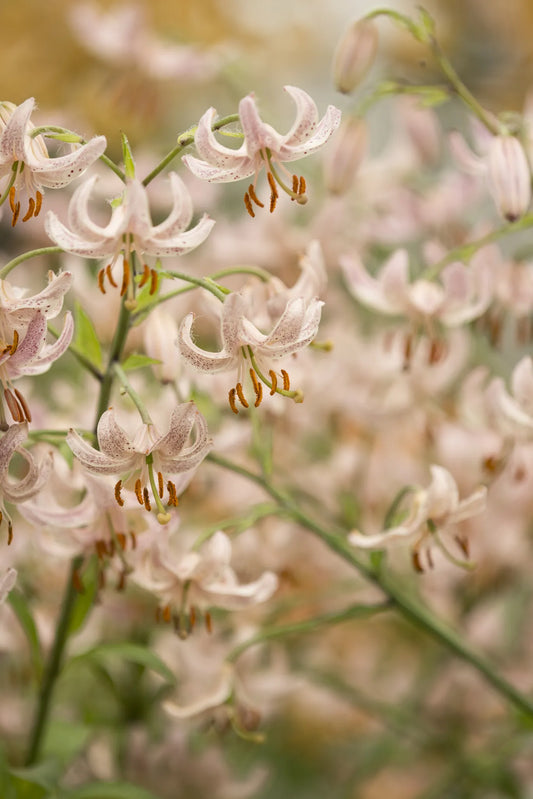
Liliums blend elegantly into a variety of landscape settings, adding height and structure. In beds, giant varieties create captivating focal points, while in borders, their slender stems allow smaller flowers to be combined for layered effects. Species like Lilium martagon thrive even in partial shade, under tree canopies, or within perennial beds, offering solutions for livening up less sunny areas. More compact varieties are perfectly suited to growing in pots or containers, ideal for enhancing patios and urban spaces. Lilium martagon's ability to naturalize, forming impressive clumps over time, makes it a suitable choice for long-term projects.
Applications for communities and public spaces
Liliums are prime candidates for public green spaces and communities. Their hardiness and ease of cultivation, particularly for Asiatic lilies, make them perennials requiring minimal maintenance. They tolerate a variety of French climatic conditions, thus reducing the annual replacement rate and optimizing landscaping budgets. Double-flowering varieties offer an extended ornamental period, and their reduced maintenance translates into optimized human resources.
In terms of numbers, the average lifespan is 3 to 5 years without division , with a recommended planting density of 7 to 10 bulbs/m² and a depth of 10-15 cm . Water consumption is moderate, about 40% lower than traditional annuals after establishment, and the annual maintenance cost is significantly reduced.
Contribution to biodiversity
Lilium actively attract pollinators, including moths (hawk moths) for the trumpet-shaped flowers, and bees, bumblebees, and butterflies for the open-flowered, fragrant species such as Lilium candidum and Lilium martagon. Most scented lilies produce significant amounts of nectar and pollen, key to attracting pollinators during their peak bloom, usually from June to August. A tiger lily (Lilium lancifolium) plant can bear up to 30 flowers per stem , providing ample opportunities for visitors.
Technical plant associations
For aesthetic effects and complementary cultural benefits, Liliums combine harmoniously with perennials with decorative foliage such as hostas, hardy geraniums, and ferns, which contrast textures and volumes. Partial shade plants such as astilbes, heucheras, and foxgloves create a prolonged summer bed. Ornamental grasses, such as Stipa tenuissima, bring lightness without competing with the lilies.
From a cultural perspective, intercropping with plants that share similar requirements (Iridaceae, Amaryllidaceae) is beneficial. Alliums, for example, are known for their repellent properties against certain pests, limiting aphid infestations. A spacing of 20 to 30 cm between lily bulbs and 30 to 40 cm between companion perennials is recommended to optimize growth.
Post-flowering management
After flowering, the ornamental value of Lilium is primarily functional. The foliage, composed of elongated, lanceolate to linear, dark green, glossy leaves, is crucial for recharging the bulbs with nutrients via photosynthesis. It is imperative not to cut the foliage while it is green, but to wait for its natural yellowing, generally in autumn, to allow the bulbs to store maximum energy for future flowering. A notable exception is Lilium candidum, which maintains a persistent basal rosette in winter. Monitoring and eliminating red lily beetles is essential to preserve the photosynthetic capacity of the foliage.
Planting techniques and seasonal management
Successful Lilium cultivation relies on rigorous planting and seasonal management practices, tailored to the requirements of each variety.
Optimal planting calendar
The optimal time to plant Lilium bulbs in France is mainly in autumn, between September and November , before the first frosts. In regions with mild winters, autumn is preferable because the soil, still warm and moist, encourages rooting. For regions with very harsh winters, planting in early spring (March to April) is recommended to avoid frost damage, ensuring that the soil temperature is above 8-10°C . The Madonna Lily (Lilium candidum) is an exception and must be planted strictly in autumn (September-October), because its foliage develops during this period.
Technical depth and spacing
Planting depth is crucial and depends on the type of root system. For cauline-rooted lilies, which produce roots both above and below the bulb, a depth of 15 to 20 centimeters is recommended. For basal-rooted lilies, which only develop roots below the bulb, 5 to 7.5 centimeters is sufficient. A general rule of thumb is to plant bulbs at a depth equivalent to two to three times their height, or about 15 centimeters for a standard 5 cm diameter bulb . The Madonna lily (Lilium candidum) is planted less deeply, at only 3.5 centimeters . The recommended spacing between each bulb is 15 to 20 centimeters to ensure optimal development and limit competition for nutrients.
Soil and drainage requirements
Liliums require open, loose, and well-drained soil. An optimal mix consists of 2 parts sandy loam, 2 parts peat, and 1 part sand , ensuring good aeration and adequate moisture retention. Excellent drainage is imperative as lilies do not tolerate standing water; planting on a slight slope or in a raised mound may be considered. The ideal soil pH is between 6.0 and 6.5 , i.e., slightly acidic to neutral. The soil should be rich in organic matter, with a well-rotted supply recommended. Soil temperature for rooting is ideally around 9°C .
Required light exposure
For Liliums, the optimal light exposure is full sun, requiring at least 6 hours of direct sunlight daily for abundant flowering and optimal development. Full sun corresponds to an exposure where the sun's rays directly hit the foliage for at least 5-6 hours per day. Although Liliums adapt to different types of soil, they prefer rich, humus-rich soils, always associated with this sunny exposure. Light protection can be considered in case of excessive sunlight during the summer, while maintaining sufficient light. Partial shade is tolerated, but can reduce the quality and quantity of flowering.
Need for vernalization
Vernalization is a mandatory requirement for most Lilium grown from bulbs, especially Lilium longiflorum, to induce flowering. A prolonged period at low temperatures is essential to transition from vegetative growth to flowering. The optimal range is between 2°C and 10°C , with maximum effectiveness around 4°C . A duration of 6 to 9 weeks at 4°C is usually sufficient to saturate the vernalization effect, resulting in a reduction of the time to flowering by about 80% . Without this cold period, bulbs may produce only foliage without flowering.
Growing in containers and under cover
Growing Lilium in pots or under cover (greenhouse, tunnel) is quite effective for the production of cut flowers or ornamental potted plants, allowing better control of environmental factors. The substrate must be light, well-draining and aerated, with an ideal mixture consisting of 60-70% blond peat or coconut fiber, 20-30% perlite or coarse sand, and 10% mature compost . A drainage layer at the bottom of the pot is essential. The optimal pH of the substrate is 6.0 to 6.8 .
Bulbs should be planted at a depth of two to three times their height, and a 30 cm diameter pot can accommodate 5 to 6 bulbs spaced 4 to 5 cm apart . Watering should keep the substrate fresh but not soggy, with weekly watering or as soon as the top 5 cm of the substrate dries out. Ideal temperatures are 5 °C for rooting for 2 to 3 weeks , then 15 to 18 °C for steady growth , in strong but not hot light.
Botanical and physiological characteristics
Beyond the cultural aspects, an in-depth knowledge of the botanical and physiological characteristics of Lilium is a valuable asset for professionals.
Scientific nomenclature
The full scientific name of the lily is Lilium (genus) , with many species such as Lilium candidum, Lilium regale, Lilium martagon, etc. To designate the group without specifying the species, the notation Lilium spp. is used. The botanical family of Lilium is Liliaceae . This genus has about 100 species of perennial bulbous plants, native mainly to the Northern Hemisphere (Europe, Asia, North America). It is important to distinguish "true lilies" (Lilium) from other bulbous plants called "lilies" but belonging to other families, such as Amaryllidaceae for Easter lilies.
Geographic origin and habitat
Lilium are native to the Northern Hemisphere, with a very widespread geographical distribution. They are found in Europe, Asia (Japan, India, Indochina, Philippines) and North America (from southern Canada to a large part of the United States). In France, some species such as Lilium bulbiferum are naturally present in the Jura, the Alps and Provence. They are adapted to varied biotopes, notably humid forest environments in mountainous areas, more rarely meadows or open environments. Some species are even epiphytes or epilyths. They generally prefer moderately acidic or lime-poor soils and are adapted to temperate to subtropical climates.
Structure of the bulb
Lilium has a scaly, non-tunicate bulb, composed of fleshy scales nested around a basal plate. Unlike tunicate bulbs (onion, tulip), it does not have a protective envelope, which makes it fragile and susceptible to desiccation and mechanical injury. Bulb sizes generally vary from 4 to 18 cm in circumference , depending on the commercial size and species (e.g., 12-14 cm for Asians, 16-18 cm for some hybrids). The color of the scales is generally white to ivory, sometimes slightly pinkish. Some Lilium produce axillary bulbils or multiply by short rhizomes.
Leaf characteristics
Lilium foliage is characterized by elongated, lanceolate to linear, tapered leaves ending in a point. Their length varies, reaching for example 15 to 20 cm for the basal leaves of Lilium candidum . The arrangement on the stem can be alternate, whorled or spiral. The texture is generally fine, firm, smooth and shiny, offering a glossy appearance. The color varies from medium green to dark green, sometimes with red shades under the effect of cold, as in Lilium candidum. The majority of Lilium have deciduous foliage, drying in autumn-winter, with a vegetative restart in spring. Lilium candidum is an exception, retaining a persistent basal rosette in winter. The duration of the foliage presence generally extends from 4 to 6 months, from March-April to July-September .
Floral morphology
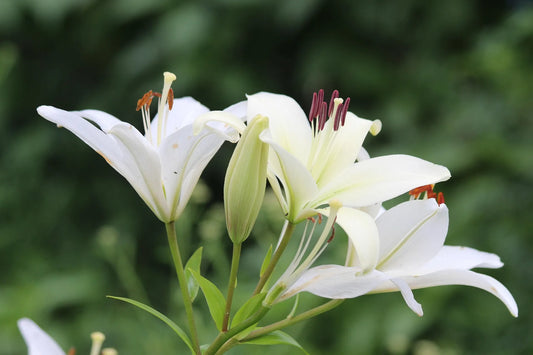
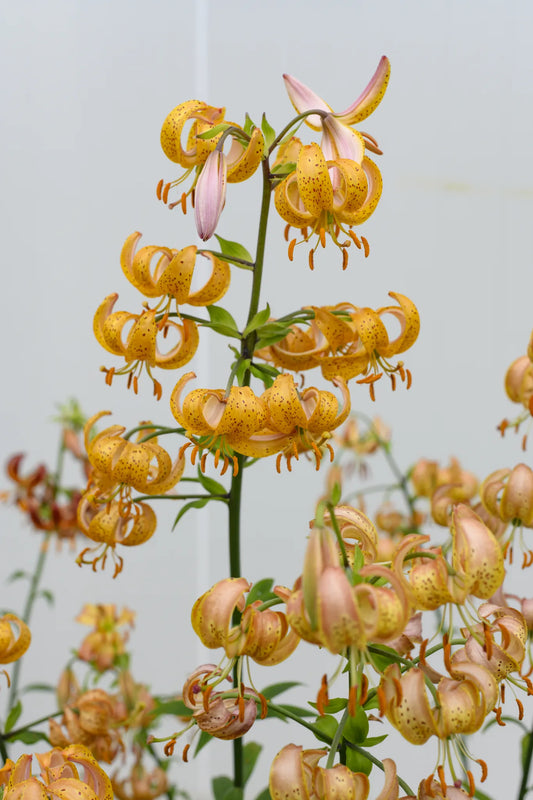
Lilium flowers are generous and often very fragrant. They are typically funnel-shaped and can be large, sometimes requiring staking. The color palette is diverse, including orange-red tones (Lilium bulbiferum) and many other shades depending on the variety. The fragrance varies in intensity, with some cultivars being very fragrant. Stems may bear several flowers, increasing their ornamental value. Flowering generally extends from May to October, providing a long commercial season. Regularly cutting off spent flowers encourages continued flowering. Individual flowers measure between 2 and 20 cm in diameter, sometimes reaching up to 30 cm , and are composed of six tepals.
Dimensions and vegetative port
The mature height of Lilium varies considerably depending on the species and variety. It is generally between 60 cm and 1.50 m , and can exceed 2 m for some varieties in optimal conditions. For example, oriental lilies measure around 60 cm, Lilium martagon up to 1.50 m, Lilium auratum 1.60 m, and Lilium candidum 1.20 m. The habit is mostly erect (upright), facilitating the production of cut flowers and integration into clumps.
Flowering calendar
Lilium flowering mainly extends from June to August , but can begin as early as May-June and continue until September depending on the variety. The flowers bloom sequentially on the same flower stalk, extending the flowering period. Autumn planting in regions with mild winters allows for normal flowering from the first year, while spring planting may result in a slight delay. Partial shade exposure is appreciated, especially for the base of the plant ("cold feet").
Climate resistance
Most Lilium are hardy and tolerate temperatures down to -20°C to -25°C (USDA zones 5 to 6) . Some hardier botanical species, such as Lilium martagon or Lilium lancifolium, can withstand temperatures close to -30°C (USDA zone 4) . In metropolitan France, the majority of growing zones (USDA 6 to 8) are suitable for growing the main horticultural Lilium.
Biological cycle and sustainability
Lilium is a perennial bulbous plant. The life cycle begins in spring with the growth of young stems, progressing to full bloom in summer. After flowering, most Lilium are deciduous and lose their foliage for the winter, entering dormancy. Lilium candidum is the exception, retaining a basal rosette of leaves in winter but entering a summer dormancy. The bulbs, consisting of scales without a protective tunic, are vulnerable to drying out. They are generally planted deep, except for Lilium candidum. Some lilies develop cauline roots on the stem above the bulb, which helps anchor them. As a perennial, Lilium can live for several years in the same location if cultural conditions are favorable. Planting is mostly done in the fall, but can extend as far as March.
Multiplication methods
Liliums are propagated primarily by asexual methods. Bulb division is the simplest method, consisting of digging up and separating overly dense clumps in late summer or early autumn. Scaling is an effective technique for rapid propagation: scales taken from the mother bulb (6-8 weeks after flowering) form bulbils that can reach marketable size in 1 to 2 years . A single mature bulb can provide 20 to 30 scales . Some varieties, such as tiger lilies, naturally produce axillary bulbils in the leaf axils, which can become mature bulbs in about a year.
Main commercial selections
Liliums fall into several categories: Asiatic Lilium , which is hardy and easy to grow; Oriental Lilium , known for its spectacular flowers and fragrance; and Oriental Trumpet (OT) Lilium , which combines grandeur and resilience. Notable cultivars include commercial series such as 'Beau Monde', 'Come Back', 'Explosion', 'Lefeber's Memory', 'Pink Impression', 'Purple World', and 'Spryng', as well as 'Fusarino' and 'Furand'. Lilium candidum (White Lily) is distinguished by its height of over one meter, its large, pure white, highly fragrant flowers from May to July, and its hardiness.
Commercial production and yields
Standard yields in intensive cultivation
In commercial cultivation, the optimum density is about 9 bulbs per square meter , leading to a standard expected yield of 9 commercial flower stems per square meter . Each bulb usually produces one flower stem, although certain favorable conditions may result in two. Asian and Oriental hybrids, as well as Lilium longiflorum, are most commonly used for cut flowers. Well-drained, humus-rich soils and a sunny to partially shaded exposure are essential for optimal yield.
Water requirements and fertilization
Lilium has significant water requirements, which vary according to its growth cycle. Requirements are low at the start, increase sharply during active growth and flowering (constantly moist but well-drained soil), and then decrease during the senescence phase. Total requirements are estimated at between 400 and 500 mm of water per hectare . Drip irrigation is recommended for irrigation.
In terms of fertilization, Lilium is demanding, particularly in nitrogen, phosphorus, potassium, calcium and magnesium. Before planting, a base dressing is recommended ( 60-80 units N, 80-100 P₂O₅, 120-150 K₂O/ha ). A split nitrogen supply and a potassium supply are crucial during cultivation. All inputs must be adjusted via soil analyses.
Seasonal protection and mulching
Mulching is highly recommended for Liliums. A 5-7 cm layer of organic mulch applied in late autumn protects the bulbs from the cold, maintains soil moisture, and limits weeds. Materials such as pine bark, dead leaves, straw, or mature compost are ideal. Deep planting (15-20 cm) also improves natural frost protection. Excellent drainage is vital to prevent bulb rot in winter. In very harsh regions, a winter blanket and 8-10 cm of mulch may be necessary.
Routine cultural maintenance
Routine maintenance includes regular watering to keep the soil moist but never soggy, stopping once the foliage has dried. Fertilization should be carried out with a special bulb fertilizer at flowering, or a liquid fertilizer twice a month during growth, favoring potassium and phosphorus. Mulching helps keep the soil cool and limits weeds. Removing faded flowers is essential to prevent seed formation, leaving the stem and leaves intact. The foliage should only be cut back to ground level in autumn, once completely dry, to allow the bulb to replenish its reserves. Regular monitoring for aphids, mites, and signs of rot is necessary. Lifting bulbs is only required for cold-sensitive varieties, with storage at 10-15°C.
Phytosanitary and crop protection
Main fungal diseases
Lilium plants are prone to several pests and diseases. Fungal diseases include Botrytis elliptica (lily blight) , which causes brown spots on the leaves and can lead to complete defoliation, especially in humid conditions. Fusarium oxysporum f. sp. lilii (fusarium wilt) and Rhizoctonia solani cause bulb and root rot. Viral diseases (e.g., Tulip breaking virus) cause mottling, streaking, and dwarfing.
Specific pests
The main pests are the lily leaf beetle (Lilioceris lilii) , whose larvae and adults can completely defoliate the plant, and aphids, which carry viruses. Rodents, slugs, and snails can also damage bulbs and young shoots. Preventive measures include spacing plants, removing infected parts, using certified healthy bulbs, vector control, and crop rotation.
Harvesting and preserving bulbs
Lilium bulbs are harvested after flowering, usually around September , when the foliage begins to yellow and dry out, to ensure the accumulation of reserves. The bulbs must be dug up gently, cleaned, and selected for their firmness and absence of lesions. The axillary bulbils can be harvested in late summer. For propagation, scales can be taken from the mother bulb (each bulb can provide 18 to 25 new plants ). Bulbs are stored in a cool ( 7-10°C ), slightly humid ( 60-70% RH ) medium such as peat or vermiculite, for a period of a few weeks to a maximum of 3-4 months .
Crop rotation
A crop rotation of at least 5 years
To summarize: Our Lilium bulbs
The Lilium bulbs offered by Floriverse meet the requirements of professionals in the floral sector. As a specialist wholesale supplier of Lilium bulbs , we rigorously select each batch to guarantee impeccable horticultural quality. The bulbs are calibrated for optimal production of cut flowers or for landscaping, with flowering lasting from May to September depending on the variety. Thanks to their excellent recovery rate, their adaptability to different climates and their ability to naturalize, Lilium bulbs are safe bets for any professional floral project. Choosing to buy Lilium bulbs from Floriverse means benefiting from a stable supply, precise growing advice, and high-performance varieties such as Lilium candidum, Lilium martagon or even oriental and Asian hybrids. With our logistics network, we deliver throughout France as quickly as possible. Whether for cut flowers or landscaping, buying Lilium bulbs ensures you an excellent return on investment. Trust Floriverse , your specialist wholesale supplier of Lilium bulbs , for your next planting campaigns. For more details or to purchase Lilium bulbs in large quantities, our team is at your disposal. Do you have a specific project? Our specialists will assist you with targeted recommendations. As a specialist wholesale supplier of Lilium bulbs , we put our expertise at the service of your success.