Why choose Floriverse as your specialist wholesaler?
1. Complete short circuit – from the field to your plot
At Floriverse, Corydalis bulbs are grown and packaged by our own horticultural partners, with no middlemen involved. This means you benefit from stable producer prices and rigorous quality control on each batch (size, health, consistency).
2. B2B logistics calibrated for professionals
-
Real-time availability: daily stock updates; in a sector where supply is limited, it is advisable to reserve your varieties 3 to 6 months in advance to guarantee varietal choice.
-
Express preparation: during the season, delivery within 7 to 15 days throughout France and Europe. Outside Europe is possible upon request.
-
Optimized packaging: packaging varies according to the volume ordered; we select the most protective solution for the health of the bulbs while guaranteeing the best optimization of logistics costs.
-
Delivery: France delivered within 7 days, Europe within 15 days; for destinations outside Europe, we prepare a tailor-made offer. Incoterms DAP or FCA of your choice.
-
Proactive monitoring: real-time tracking by our teams.
3. Horticultural expertise
Founded in 2024 by plant enthusiasts, Floriverse offers its expertise in flower bulb cultivation to professional florists. Our technical team advises you on:
- the choice of planting calendars (open field / greenhouse forcing),
- optimal densities to maximize the rate of marketable stems,
- integrated management of pests and sustainable fertilization.
4. Guarantees & customer reviews
-
Google Rating: 5/5
Responsiveness, speed and product quality are the most cited points.
Recent customer excerpts
“The plants are of high quality, extremely careful delivery.” — S. Aubailly (May 2025)
“Responsiveness, professionalism, good price.” — A. Benedetto (Feb. 2025)
“Superb blackcurrant plants, accommodating service.” — F. Laurent (March 2025)
“Responsiveness, friendliness and top-notch products.” — E. Fleurat (Jan. 2025)
“Professional advice, fast delivery, impeccable quality.” — V. Morales (Nov. 2024)
“Unbeatable prices and impeccable customer service.” — AC (Dec. 2024)
How to order from Floriverse?
Request your personalized quote now – response within 48 hours for a batch of Corydalis bulbs:
We open your wholesale account in less than 24 hours, with no activation fees, and provide a customized quote based on your volumes.
Technical applications of Corydalis bulbs
Corydalis are plants of great ornamental versatility, perfectly suited to various landscaping applications thanks to their specific technical characteristics.
Integration into landscaping
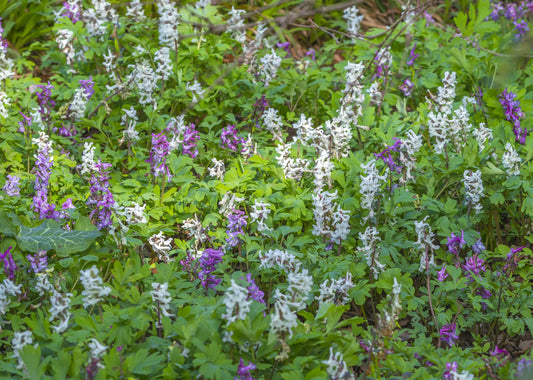
Corydalis solida and other species generally reach a modest height, between 0.15 and 0.25 meters , with a width of 0.20 to 0.30 meters . These dimensions make them an ideal choice for foreground plantings or as ground cover. They fit harmoniously into several types of layouts:
- Undergrowth and wooded areas: They thrive particularly well under large deciduous trees, creating spectacular floral carpets in spring and benefiting from ideal dappled shade.
- Shady rock gardens: Their small size and adaptation to partial shade make them an excellent choice for rock gardens requiring low vegetation.
- Ground cover: This is one of their major uses, forming dense and colorful plant mats.
They combine aesthetically with silver Brunnera , Calla Lilies (Arum maculatum) and Stag's Tongue Fern (Asplenium scolopendrium), which provide textural contrasts. Emerging Tulips also offer complementary height and spring blooms. Yew topiaries can create an interesting structural effect in shade gardens.
Capacity for naturalization
Corydalis bulbosa naturally propagates by seed, giving it excellent naturalization capacity without intensive human intervention. This characteristic allows the plants to spread and form dense colonies over the years. However, it is important to note that it can become invasive under certain conditions, requiring appropriate management based on management objectives. Its foliage is deciduous and generally disappears in summer after flowering, a technical aspect to consider when planning plant successions.
Relevance for communities and large public spaces
Corydalis represent an efficient technical choice for communities thanks to several advantages:
- Ease of maintenance: Robust and adapted to temperate climates, they are resistant to cold, which allows for a long-term establishment with little maintenance after installation. Watering and fertilization requirements are low, thus reducing costs and workload.
- Long-lasting flowering and ornamental value: Early flowering, from March to May depending on the species, ensures a strong visual impact as soon as winter ends, over a period of 4 to 6 weeks . Their ability to naturalize allows for an increasing mass effect over the years, limiting the growth of weeds and contributing to the cleanliness of spaces.
- Biodiversity: By flowering early, Corydalis provide essential nectar resources to pollinating insects (honeybees and bumblebee queens) from early spring, actively contributing to the ecological enrichment of green spaces. For Corydalis cava, the average sugar production is 4.6 kg/ha and pollen 2.1 kg/ha ; for Corydalis solida, these figures reach 5.2 kg/ha of sugar and 4.1 kg/ha of pollen. A planting density of 50 to 70 bulbs per square meter is recommended for a covering effect in two seasons.
Post-flowering ornamental interest
After flowering, the main attraction of Corydalis lies in its decorative foliage . Finely cut, with a feathery texture, it brings lightness and volume to the beds. In some varieties such as Corydalis 'Spinners', the bright apple-green foliage contrasts with the dark red stems, offering a sophisticated play of colors. This foliage persists for a long time, forming a dense clump that gradually spreads, ensuring a lasting ornamental presence. Species such as Corydalis nobilis can even take on a beautiful red hue after flowering, further enriching the landscaping. The clump maintains a height of 15 to 60 cm (20-25 cm for Corydalis solida) and an average spread of around 20 cm .
Planting techniques and seasonality
Planting schedule and depth
The optimal time to plant Corydalis bulbs or rhizomes is in the fall, from September to November , or in early spring, from February to April . It is imperative to avoid periods of frost or severe drought. Planting should be done when the soil temperature is above 5°C to ensure adequate root recovery and prevent bulb rot. Although they can be installed all year round if they are in a pot, the soil should never be frozen or dry at the time of installation.
Bulbs should be planted at a depth of 10 to 15 cm , with the buds (eyes) facing upwards. For Corydalis solida, a depth of precisely 7 cm is recommended. The ideal spacing between each bulb is 15 to 20 cm in the open ground; slightly closer spacing is possible in containers. For group plantings, maintain a distance of at least 10 cm, and ideally 20 to 30 cm , for optimal development. Adding leaf mold mixed with the surface soil encourages root recovery and development.
Soil type and drainage
Corydalis thrive in light, humus-rich, fertile soils , reminiscent of "undergrowth soil." They do not tolerate heavy, clayey, compact, or excessively calcareous soils well. The optimal pH is between 6.0 and 7.0 (neutral to slightly acidic), and excessively calcareous soils (pH > 7.5) should be avoided. Excellent drainage is essential, as the bulbs are very sensitive to stagnant moisture, especially in winter. The soil should remain fresh but well-drained in spring and early summer, without ever being soggy. Amending heavy soils with coarse sand and compost is recommended to improve drainage.
Light exposure
Most Corydalis prefer a partial shade exposure, ideally receiving between 3 and 6 hours of direct sunlight per day, preferably filtered or in the form of subdued light. Strong afternoon sun, especially in midsummer, should be avoided as it can cause rapid drying of the substrate and premature dormancy. Planting bulbs under deciduous trees, along hedges, or in situations where the light is soft (east or west exposures) is preferable. In a greenhouse, 40 to 60% shade is recommended in cases of intense sunlight.
Water and fertilization requirements
Corydalis are generally low water requirements, liking fresh but well-drained soils. During their vegetative period (active growth and flowering), regular watering is necessary in case of drought or on light soils, to keep the substrate slightly moist. It is advisable to water when the first 2 to 3 centimeters of soil are dry, providing approximately 5 to 10 liters of water per square meter every 1 to 2 weeks in dry periods. Excess water, especially in winter and during dormancy, should be avoided at all costs to prevent bulb rot. Under cover, water inputs should be reduced to approximately 80% of the local ETP .
In terms of fertilization, Corydalis are not very demanding. A basic fertilization with 100 to 150 g/m² of well-rotted compost or a complete organic fertilizer (type 5-5-5 or 7-4-4) is recommended at planting. For maintenance, a light application of 30 to 50 g/m² of organo-mineral fertilizer (type 3-2-4) at emergence is generally sufficient, which can be repeated after flowering if growth is weak. It is important to watch for signs of deficiencies (yellowing for nitrogen, purple coloration for phosphorus, necrosis for potassium).
Mulching and seasonal protection
Corydalis are hardy, withstanding temperatures down to -20°C . Mulching is not always required, but is highly recommended in areas with harsh winters without snow, on heavy or poorly drained soils, or for new plantings. Apply a 5-7 cm layer of dead leaves, organic mulch, or well-rotted compost after the first autumn frost. Remove it gradually in early spring to prevent young shoots from suffocating. Summer mulching can also keep the soil cool and limit weed growth.
Vernalization
Yes, Corydalis require a period of vernalization (cold exposure) to induce and enhance flowering. A temperature between 5°C and 8°C is optimal, maintained for 4 to 6 weeks . Proper vernalization results in an increased flowering percentage, reduced flowering time, and a higher number of flowers per plant. Temperatures above 15.5°C do not produce a vernalization effect.
Growing in pots or under cover
Growing Corydalis in pots or under cover is viable, provided cultural practices are adapted. Use a well-drained but organically rich substrate, such as a mixture of coarse sand over potting soil. Apply a thick mulch to the surface to replicate forest litter. Watering should be abundant in spring during the growth spurt, then reduced or stopped in summer and autumn, as they tolerate soggy soils in spring but prefer to dry out a little in summer. Good ventilation is essential under cover. For commercial production, a finishing cycle of 5 to 6 weeks is required for 10-13 cm pots.
Botanical characteristics of the genus Corydalis
Botanical identification
The genus Corydalis belongs to the botanical family Papaveraceae , which formerly included the Fumariaceae and is now included in the latter according to current classifications (APG IV). Commonly cultivated species in France include Corydalis solida (L.) Clairv. and Corydalis cava (Schw.).
Geographical origin and natural habitat
Corydalis solida is a temperate Eurasian plant, widespread in Europe (except in the northwest), extending to western Asia and Siberia. In France, it is present over a large part of the territory but is rarer in certain regions such as the Paris Basin, Brittany, or the Mediterranean South.
It thrives in temperate climates and is best found in cool, humus-rich undergrowth in partial shade. Its preferred habitat includes ash-oak groves on humus-rich, cool to slightly damp, well-drained soils. It generally grows from the plains up to about 1,200 meters above sea level , remaining localized in valleys and damp undergrowth in the mountains. It is crucial to note that Corydalis solida is a protected species in several regions of France; it is therefore advisable to check local regulations before collecting or selling bulbs.
Bulb type and appearance
Corydalis solida has a solid tuber (sometimes called a solid bulb), rounded to ovoid in shape, compact and scaleless. Its diameter is generally between 1 and 3 cm at maturity. The outer skin is beige to pale brown in color, and the inner flesh is white to cream. This tuber is very sensitive to drying out, which requires prompt planting after receipt to maximize recovery.
Description of the foliage
Corydalis foliage is finely divided , delicate in appearance, often reminiscent of fern fronds. The leaves are bipinnate to quadripinnate, with numerous leaflets. Their length generally varies from 6 to 12 cm , reaching up to 15 cm for Corydalis flexuosa. The texture is fine, tender and slightly fleshy, soft to the touch, giving a light and airy appearance.
The foliage color is typically mid-green to bluish-green or glaucous (Corydalis flexuosa is glaucous, Corydalis scouleri is blue-green), sometimes with bronze highlights at bud break. Corydalis is a deciduous perennial for most species. The foliage appears in spring (March-April) and goes into summer dormancy if conditions are warm and dry, its period of presence extending from March to June/July (approximately 4 to 5 months). If the summer remains cool and humid, it can persist until September (6 to 7 months).
Characteristics of flowers
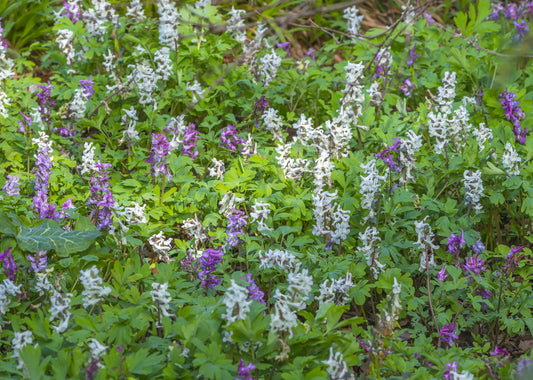
Corydalis flowers are tubular , characteristically lip-shaped, and have a spur at the back. The supporting stem is attached near the center of the flower. The flowers are grouped in terminal raceme-like inflorescences, containing several florets. Size varies by species: the upper petal can reach about 15 mm , the lower 12-13 mm, and the spur 3-4 mm. Colors vary: purple (Corydalis cava), pale yellow to almost white, or light yellow (Corydalis pallida). Some selections such as Corydalis 'Blue Line'® offer an intense blue and a sweet fragrance. The main flowering period is from April to May , although some species flower from March to May. Cutting off spent flowers can extend this period.
Average height and general bearing
The average height at maturity generally varies between 25 and 60 cm . The habit is mainly upright, with branches sometimes slightly flexible and drooping, giving an airy and dynamic appearance.
- Corydalis flexuosa: 30 to 60 cm in height and 20 to 40 cm in width.
- Corydalis Canary Feathers: 25 cm high and 30 cm in diameter, forming a compact clump.
- Corydalis elata: Reaches 45 cm in height and 20 cm in width, with a more upright habit.
Hardiness and life cycle
Corydalis are renowned for their good cold resistance, with most species being hardy to around -18°C (USDA zone 6), which is suitable for most regions of mainland France.
They are perennial plants , which can live for several years. Their life cycle is characterized by a phase of active growth in spring, followed by a period of dormancy. Some species disappear from the surface in winter, while others (such as Corydalis ochroleuca) retain reduced foliage, or enter summer dormancy (Corydalis flexuosa 'China Blue').
Multiplication modes
Corydalis propagation is best done by bulbil production (natural or manual division) or by division of the plant. Each bulbous plant generally produces 1 to 3 bulbils per year , or even more, allowing 2 to 5 usable bulbils to be separated per mature bulb. These bulbils generally take 2 to 3 years to reach full maturity and flower. This method is the fastest and most reliable for producing plants identical to the mother plant. Sowing is also possible but is more reserved for selection or the conservation of genetic variability, because the breaking of seed dormancy and juvenile growth are longer and more irregular. The germination rate varies from 20% to 60% and may require cold stratification for 3 to 5 months at 4°C. Plantlets from seed generally take 3 to 4 years before flowering.
Main cultivars and selections
For professional cultivation, several cultivars stand out:
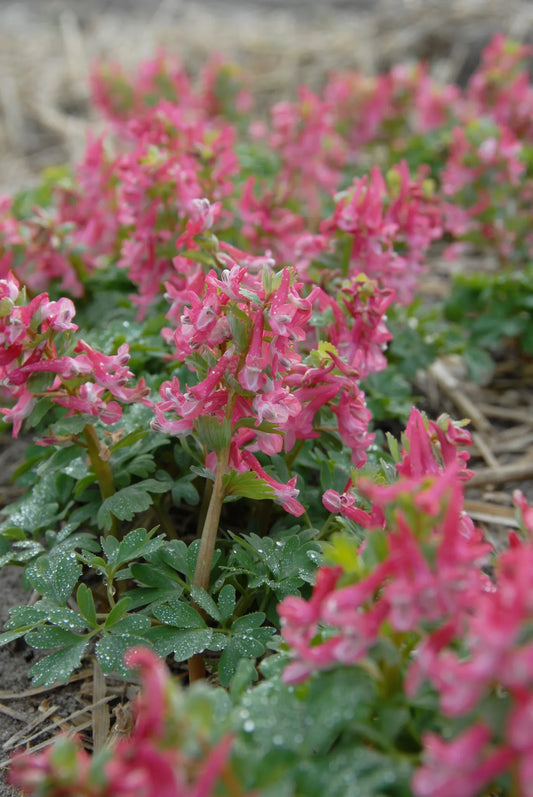
- Corydalis solida: Reaches 10 to 30 cm in height . The flowers are mostly purple, but some selections offer white or pink flowers. Its early flowering (March-May) makes it a choice for growing under cover or in the open ground in spring.
- Corydalis lutea: Measures 15 to 20 cm in height with a spread of 30 cm. It is characterized by a continuous bright yellow flowering from April to November , making it one of the species with the longest flowering period. Very hardy and with slightly bluish foliage, it is an excellent ground cover.
- Corydalis 'Blue Line'® (Couriblue): Approximately 20 cm tall . Offers an exceptionally long, intense blue bloom with a white throat from spring until frost. It is appreciated for its floral abundance, its sweet fragrance and its increased hardiness.
Notable features
Corydalis contains powerful alkaloids such as corydaline and bulbocapnine, making it remarkably toxic. Ingestion can cause nervous disorders. However, these compounds are paradoxically used in pharmacology to treat certain brain disorders, notably Parkinson's disease.
Commercially, the Corydalis solida tuber is very sensitive to drying out . Its marketing window is only about one month, which requires suitable logistics. Selling in pots is preferable to selling bare bulbs, and planting must be quick after purchase.
Performance in professional culture
Although there are no precise figures for yield in stems per square meter available in the sources consulted, a Corydalis bulb generally produces between 1 and 3 flower stems per flowering cycle. By planting 30 to 50 bulbs per square meter , a yield of 30 to 150 flower stems per square meter can be estimated, depending on the growing conditions and the vigor of the bulbs. The size of the bulbs strongly influences the performance: larger bulbs (2-3 cm) produce more abundant flowering and more vigorous plants from the first year.
Crop management and maintenance
Routine maintenance
Corydalis maintenance is relatively easy:
- Watering: Abundant during dry and hot periods to keep the soil cool. Stop watering during summer dormancy.
- Removing faded flowers: Regularly removing faded flowers stimulates the appearance of new flowers and prolongs flowering.
- Pruning: Systematically remove faded flowers and dead or damaged stems with clean tools.
- Seasonal protection: Foliage may die back in summer or during intense cold. It is recommended to mark the location of plants to avoid working the soil during dormancy. Summer mulching (flax, BRF) can keep the soil cool.
- Fertilization: Adding well-rotted compost at the very beginning of spring encourages abundant flowering.
- Pests: Slugs and snails are the main pests. Monitoring and application of iron orthophosphate in spring may be necessary.
Parasites and diseases
Corydalis can be affected by fungal parasites and bacteria, including bulb rots. Cryptosporidium, although less common, is a risk if irrigation water is contaminated.
Preventive measures include careful selection of healthy bulbs, careful water management to avoid over-irrigation, and crop rotation to reduce pathogen buildup. In case of infection, fungicide treatments, removal of diseased plants, and the use of natural antimicrobial compounds such as berberine can be considered. Regular monitoring is crucial for early detection.
Harvesting and storage
Corydalis bulbs are harvested in late spring or early summer, when the foliage has turned yellow and is dry (usually late May-early June in France). Dig them up carefully, let them dry in the shade for a few hours, clean them and remove any damaged parts. Store them in a dry, dark and well-ventilated place, at a temperature of 10 to 15°C , in paper bags, nets or on shelves, never in plastic.
The seeds should be harvested just before the capsules open spontaneously, when they are green but beginning to turn brown. It is crucial to sow them quickly after harvesting, as their viability is short and decreases rapidly if they dry out or are stored for too long. If necessary, store them in a cool, dry place in a paper envelope or small cloth bag.
Crop rotation
Belonging to the Papaveraceae family, it is imperative to avoid replanting Corydalis or other species of the same family on the same plot for at least 3 to 4 years . This helps limit the risks of specific diseases and the accumulation of weeds. A good rotation consists of alternating autumn and spring crops, favoring previous crops that leave a well-drained soil, rich in humus and nutrients, and capable of retaining water in summer. Incorporating compost before planting is beneficial.
Adaptations in case of drought or harsh winters
In periods of prolonged drought, controlled drip irrigation ( 10 to 20 L/m²/week ) is recommended, combined with a 5 to 7 cm organic mulch to limit evaporation and keep the soil cool. Temporary shading with sails (30% occultation type) can help in the event of a heatwave (> 30°C). In very harsh winters (below -10°C, or even -15°C), a thick mulch ( 8 to 10 cm ) of dead leaves or straw is recommended to insulate the bulbs. Optimal drainage with a bed of sand under the bulbs and light earthing up on the rows prevents rot linked to humidity and frost. For the most sensitive species, cultivation in a cold frame or cold greenhouse is an alternative.
Health assessment and deficiency detection
Corydalis health is assessed using several visual and physiological indicators. Healthy bulbs are uniform in color (beige to light brown), firm to the touch, free of spots or lesions, and ideally 1.5 to 2.5 cm in diameter . Foliage should be bright green to bluish, well-expanded, and firm, with no yellowing or premature wilting.
Signs of stress include early or late flowering, reduced flower size, or shortened stems. Nutrient deficiencies are manifested by: yellowing of older leaves (nitrogen), purple discoloration (phosphorus), marginal necrosis (potassium), interveinal chlorosis (magnesium on older leaves, iron on younger leaves). Soil analysis (pH 6.0-7.0, organic matter content 3-5%) is also essential for an accurate diagnosis.
To summarize: Our Corydalis bulbs
As a specialist wholesale supplier of Corydalis bulbs, Floriverse offers professionals a carefully selected range of Corydalis solida bulbs, an iconic variety for cool, semi-shaded undergrowth. Buying Corydalis Corydalis solida bulbs guarantees early flowering, excellent naturalization capacity, and finely cut foliage with strong decorative appeal. Thanks to our expertise, each batch comes from specialized nurseries and is calibrated for optimal performance: size 1.5 to 2.5 cm, high resistance to cold (down to -18°C), tolerance to root diseases, low maintenance requirements, and sustained flowering between March and May.
Our bulbs are ideally planted 7-10 cm deep with a density of 50 to 70 bulbs/m². The Corydalis solida variety is particularly suitable for shaded beds, cool rockeries, or naturalized plantings.
As a specialist wholesale supplier of Corydalis bulbs, Floriverse is committed to providing a professional-quality product, with fast delivery, suitable storage, and on-demand advice. Buying Corydalis (Corydalis solida) bulbs from Floriverse also means benefiting from personalized support and excellent value for money.
In summary, whether for planting under cover or in the ground, Floriverse , a specialist wholesale supplier of Corydalis bulbs, is your trusted partner for purchasing Corydalis Corydalis solida bulbs with complete peace of mind.