Why choose Floriverse as your specialist wholesaler?
1. Complete short circuit – from the field to your plot
At Floriverse, Anemone bulbs are grown and packaged by our own horticultural partners, with no middlemen. You benefit from stable producer prices and rigorous quality control on each batch (size, health, uniformity).
2. B2B logistics calibrated for professionals
-
Real-time availability: daily stock updates; in a sector where supply is limited, it is advisable to reserve your varieties 3 to 6 months in advance to guarantee varietal choice.
-
Express preparation: during the season, delivery within 7 to 15 days throughout France and Europe. Outside Europe is possible upon request.
-
Optimized packaging: packaging varies according to the volume ordered; we select the most protective solution for the health of the bulbs while guaranteeing the best optimization of logistics costs.
-
Delivery: France delivered within 7 days, Europe within 15 days; for destinations outside Europe, we prepare a tailor-made offer. Incoterms DAP or FCA of your choice.
-
Proactive monitoring: real-time tracking by our teams.
3. Horticultural expertise
Founded in 2024 by plant enthusiasts, Floriverse offers its expertise in flower bulb cultivation to professional florists. Our technical team advises you on:
- the choice of planting calendars (open field / greenhouse forcing),
- optimal densities to maximize the rate of marketable stems,
- integrated management of pests and sustainable fertilization.
4. Guarantees & customer reviews
-
Google Rating: 5/5
Responsiveness, speed and product quality are the most cited points.
Recent customer excerpts
“The plants are of high quality, extremely careful delivery.” — S. Aubailly (May 2025)
“Responsiveness, professionalism, good price.” — A. Benedetto (Feb. 2025)
“Superb blackcurrant plants, accommodating service.” — F. Laurent (March 2025)
“Responsiveness, friendliness and top-notch products.” — E. Fleurat (Jan. 2025)
“Professional advice, fast delivery, impeccable quality.” — V. Morales (Nov. 2024)
“Unbeatable prices and impeccable customer service.” — AC (Dec. 2024)
How to order from Floriverse?
Request your personalized quote now – response within 48 hours for a batch of Anemone bulbs:
We open your wholesale account in less than 24 hours, with no activation fees, and provide a customized quote based on your volumes.
Professional markets and commercial opportunities for Anemone
The Anemone, often nicknamed "windflower," is a species of great interest to professional horticulture and floriculture. Its versatility makes it suitable for several strategic markets.
National production of cut flowers
Firstly, it is an essential cut flower on the French market, particularly appreciated for its spreading flowering, its excellent vase life and its remarkable diversity of colours. National production is dynamic, with a notable concentration in the PACA and Pays de la Loire regions . The Anémone du Var, for example, is known for its large stems reaching up to 45 cm , straight, rigid and strong enough for use as a cut flower.
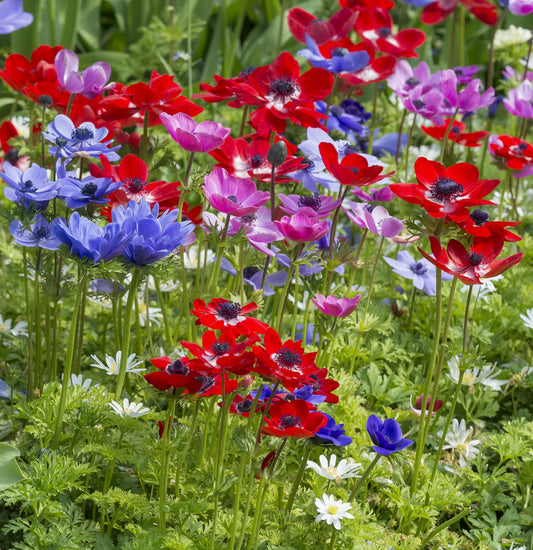
Modern varieties, such as the "tetranemones" or the Mona Lisa and Marianne lines, offer thicker, longer stems and larger flower diameters, improving quality for florists and professional buyers. Vase life averages 7 to 10 days , with a potential of 11 days with proper treatment, which is an asset for this segment. Although generally odorless, its color palette, including pure white, various pinks, subtle blues and intense purples, more than compensates for this lack of fragrance in commercial interest.
Landscaping and collective spaces
Beyond the cut flower, the Anemone fits perfectly into sustainable landscaping and the enhancement of public spaces. Its robustness and ease of maintenance make it a relevant choice for town halls, green space departments, private estate managers, and landscapers. It is used in flowerbeds, borders, rockeries, lawns, flower meadows, or even at the base of trees.
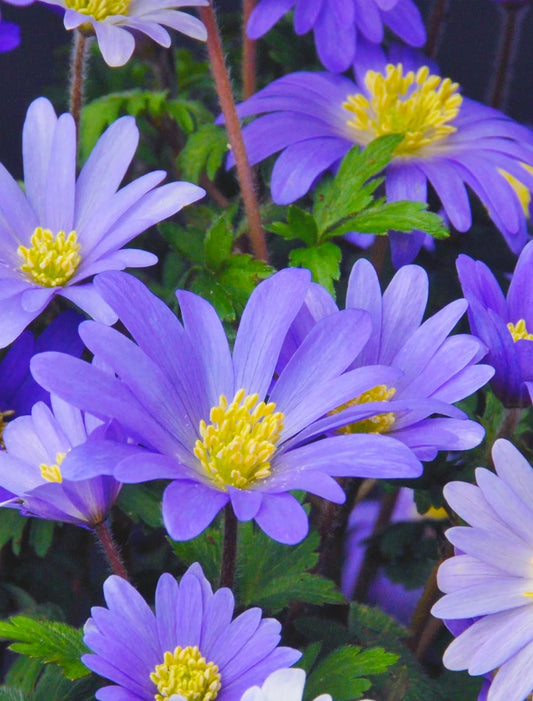
Species such as the Caen Anemone (Anemone coronaria) are ideal for dense flowerbeds (recommended density of 25 to 75 bulbs/m² ) and the Greek Anemone (Anemone blanda), which is lower, is suitable for borders and rockeries ( 40 to 60 bulbs/m² ). It combines well with other spring bulbs such as tulips, creating an interesting visual layering. Its naturalization capacity, particularly for species with rhizomes or spontaneous seeds such as Anemone nemorosa or Anemone blanda, allows it to quickly cover large areas, a major asset for the management of large public spaces requiring little maintenance.
Honey and biodiversity development
Finally, the Anemone is a honey plant that attracts various pollinators, mainly solitary bees, bumblebees, butterflies, hoverflies and flies, particularly active from March to June , a period when floral resources are precious. This characteristic is valuable for farms wishing to support functional biodiversity.
Technical mastery of planting and cultivation calendar
The success of a professional Anemones culture is based on the mastery of several technical parameters, from planting to the management of the vegetative cycle.
Selection and preparation of corms
The reserve organ of the cultivated Anemone, such as Anemone coronaria or Anemone blanda, is not a bulb in the strict sense but a corm , a dry and hard underground mass, different from a tunic bulb or a tuber. These corms are classified by caliber (diameter), ranging from 2/3 cm to 7/8 cm . For high-yield professional production, it is recommended to favor large calibers (4/4 cm and beyond, ideally 5/6 or 6/7), because they have more reserves, ensuring better vigor, earlier flowering and a higher number of stems from the first year ( 15-18 stems/foot for large calibers against 7-10 for smaller ones).
Planting calendar and techniques
The optimal planting period in France is generally autumn, from September to October , to allow the corms to take root before winter and guarantee spring flowering. Spring planting is also possible, particularly in regions with very cold or wet winters. Before planting, a crucial step is to rehydrate the corms by soaking them in water for 6 to 24 hours , which promotes rapid and even recovery.
Soil preparation and edaphic conditions
The choice and preparation of the soil are crucial. Anemone prefers light, deep soil, rich in organic matter (enriched with compost or decomposed manure), and above all very well-drained . A slightly acidic pH (6.0 to 6.8) is optimal. Heavy, compact or waterlogged soils should be avoided at all costs, as excess moisture causes the corms to rot. The soil should be worked finely to a depth of 20 to 25 cm before planting.
Setup Settings
The planting depth is between 5 and 10 cm , with a recommended average of 8 cm . It is important to position the pointed part of the corm upwards . The spacing varies according to the desired effect: 5 cm for a dense mass effect in intensive production, and 10 to 15 cm for optimal development of each plant. The density can reach 75 bulbs/m² for a carpet effect.
Flowering cycle and time management
Anemone flowering extends, depending on the species and cultivation method, from March to October . For Anemone coronaria in the open ground, it takes place from April to June , while in forced greenhouse crops, it can begin as early as November and continue until March . A well-managed plot with staggered plantings can offer continuous production for 6 to 10 weeks . The lifespan of a cut flower is 5 to 10 days on the plant.
Anemone is primarily a perennial plant , capable of reflowering each year from its underground organs and living for 3 to 10 years on average, or even 15 to 20 years for robust species in good conditions. In intensive production for cut flowers, it is often managed as an annual to maximize productivity and batch uniformity, by renewing the corms each year.
Professional crop management and maintenance
Routine maintenance of Anemone in professional cultivation aims to optimize production and quality. Rigorous weeding is essential, ideally every 2 to 3 weeks , because competition from weeds harms floral development. Mulching, whether biodegradable or plastic, is an effective method for reducing the workload associated with weeding.
Optimized water management
Watering should be regular, especially during the first growing season and during periods of drought, but it is crucial to never let the soil get soggy to prevent corm rot. Fresh but not waterlogged soil is key. In midsummer, during the summer dormancy of spring varieties, anemones tolerate dry soils and watering may be unnecessary. A localized irrigation system such as drip irrigation is recommended to optimize water supply and limit fungal diseases. A 5 to 7 cm layer of mulch also helps retain soil moisture.
Flower care techniques
The systematic removal of faded flowers , at least once a week or at each harvest, is essential to stimulate the production of new stems and prolong flowering.
Fertilization program
Fertilization should be appropriate. Soil rich in organic matter is often sufficient, but adding bulb fertilizer every 3 to 4 weeks during active growth can be beneficial. A balanced NPK 10-10-10 formulation is recommended.
Renewal and division of tufts
To maintain vigor and floridity, it is recommended to divide the clumps every 3 to 5 years , after flowering, in spring or autumn. This practice helps regenerate the stock and prevents soil depletion.
Growing under cover and forcing
Growing under cover (cold greenhouse, tunnel) or in pots is entirely possible and even recommended for professional production, particularly for forcing and controlling conditions. This allows for off-season flowering (as early as November in a greenhouse) and improves flower quality. When growing under cover or in pots, it is essential to use a very draining, light and rich substrate , to ensure adequate ventilation and to control watering to avoid excess. Forcing requires precise management of temperature ( 12-18°C ) and photoperiod ( 12-14h of light ). Vernalization (cold period) of the corms, by soaking followed by storage at low temperature (around 0.5°C ), can also accelerate and standardize flowering, although effectiveness may vary among modern cultivars.
Crop rotation and prophylaxis
Crop rotation is essential to prevent the accumulation of soil pathogens and maintain crop health. It is advisable to wait at least 3 to 4 years before replanting anemones in the same location. Rotations with unrelated crops, such as Lisianthus, Limonium, Peony, or Hydrangea , are recommended. Rotations with species susceptible to the same diseases, such as Chrysanthemum, should be avoided.
Plant health indicators
In terms of plant health, visual indicators such as bright green foliage , compact rosettes , and flowers that open and close regularly indicate good health. Yellowing foliage, reduced flowering, or poor-quality flowers can indicate stress or a deficiency.
Professional and sector support
The French Anemone industry is supported by organizations such as VALHOR , which provides market data, promotes the sector and quality labels such as "Fleurs de France" , a major sign of distinction for producers. Purchasing Anemone bulbs from a specialist wholesale supplier such as Floriverse , which offers technical support and sizes adapted to professionals, is a guarantee of success. They notably offer untreated and certified organic bulbs , meeting the challenges of sustainable agriculture.
To summarize: Our Anemone Bulbs
Thanks to its exceptional versatility, the Anemone is a must-have for floriculturists, communities, and landscapers looking for high-performance bulbs. Its generous flowering, its 7 to 10-day vase life, and its wide color palette make it a highly sought-after cut flower. By choosing to buy Anemone bulbs from Floriverse, you gain access to a rigorous selection of professional-grade corms, including the best lines such as 'Mona Lisa', 'Marianne', and the famous Anemones de Caen, suitable for intensive production or high-density landscaped beds.
Floriverse, as a specialist wholesale supplier of Flower Bulbs , is committed to providing controlled batches, without post-harvest treatment, packaged for easy and uniform planting. Our technical advice covers the entire growing cycle: soaking and rehydration, optimal substrate, rational irrigation, forcing under cover or planning in the open ground. Whether you grow in a greenhouse or outdoors, buying Anemone Bulbs from Floriverse ensures you personalized support, with express delivery times and responsive monitoring.
By using Floriverse, you're collaborating with a specialist wholesale supplier of flower bulbs committed to the industry, with a complete catalog including classic, organic, and "Fleurs de France" certified anemones. You gain peace of mind regarding volumes, availability, and the health of the corms. For an effective cultivation strategy and optimal use of your land, buying Anemone Bulbs from Floriverse is a strategic, sustainable, and profitable choice.