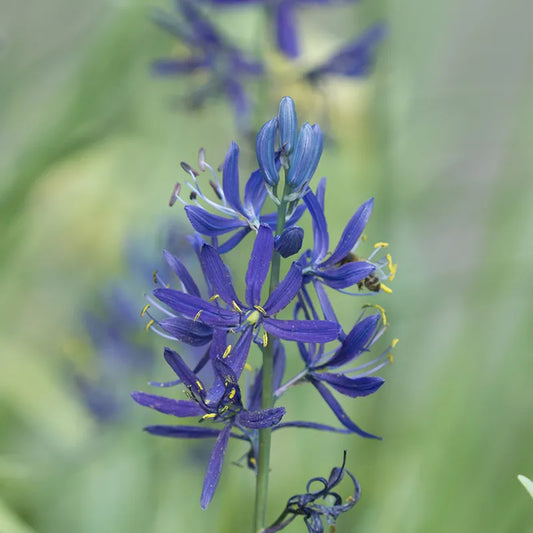
Order your professional Camassia bulbs
Floriverse, a specialist wholesale supplier of Camassia bulbs, offers cut flower growers high-end plant material, sourced exclusively from specialist nurseries. Buy your Camassia bulbs and benefit from producer prices , consistent professional quality , dedicated technical support , a responsive sales department , decreasing prices according to your volumes, fast and careful delivery throughout France and complete batch traceability. Our homogeneous batches, with varietal resistance , ensure high yield and disease tolerance . Personalized advice optimizes planting density and fertilization to maximize your margin. Order now , take advantage of our producer prices or request a free quote . Reserve your quantities now to secure your growing schedule and avoid any shortages.
Professional cultivation of Camassia: complete technical guide
Camassia is a genus of perennial herbaceous bulbous plants, whose botanical classification has evolved to stabilize within the family Asparagaceae , more precisely in the subfamily Agavoideae. Historically, it was classified among the Liliaceae or Hyacinthaceae, but genetic advances have allowed this reassignment. This genus groups precisely six distinct species , among which Camassia angusta, Camassia cusickii, Camassia howellii, Camassia leichtlinii, Camassia quamash, and Camassia scilloides.
Morphological characteristics of the bulb
The Camassia bulb is distinguished by its "tunicless" nature, unlike other bulbs. It is composed of imbricated fleshy scales, a typical characteristic of Liliaceae, and is neither a corm, a tuber, nor a rhizome. Its shape is ovoid to ellipsoid, which can be slightly flattened at the base, with a height varying from 3 to 7 cm and a diameter of 2 to 5 cm depending on the species and the degree of development. Commercial Camassia quamash is typically 3 to 4 cm high. The exterior of the bulb is generally off-white to slightly light brown, sometimes with pinkish or purplish hues, while the internal flesh is white. The fragility of these bulbs, sensitive to drying and excessive humidity, requires special attention during shipping and storage.
Foliage and plant architecture
The Camassia's foliage is also a notable visual asset. It consists of long, narrow, strap-like basal leaves of a glossy dark green . They can reach a significant length of 60 to 120 cm and emerge directly from the bulb to form a structuring basal tuft. Their texture is smooth and firm. The foliage appears in spring and remains decorative throughout the flowering period, which takes place in late spring. It gradually turns yellow and wilts after the seeds have fully formed, allowing the bulb to replenish its reserves.
Floral morphology and inflorescence
Camassia flowers are striking. They are star-shaped , each with six tepals (undifferentiated petals and sepals) and six stamens surrounding an ovary with three stigmas. The inflorescence grows in a raceme (elongated spike) on a bare flower stem, called a scape, which rises above the foliage. The flower stem typically reaches between 60 and 90 cm in height , but can extend from 30 cm to 120 cm depending on the species and cultivar. Each scape bears between 20 and 80 star-shaped flowers , 3 to 5 cm in diameter, which open gradually from the base to the top. The color palette varies from intense blue-violet to pale blue, lilac, or sometimes white, with deep blue-violet being the most common color in commercial cultivars.
Varietal range and commercial selection
For a professional supply of Camassia bulbs, it is crucial to differentiate between the main species and cultivars, which present notable variations in terms of color, height, and flowering time. Camassia sold in France mainly consists of two species : Camassia leichtlinii and Camassia quamash.
Main commercial varieties
The main cultivars available on the market include Camassia leichtlinii 'Alba', 'Caerulea', 'Aurora', as well as Camassia quamash (sometimes referred to as 'Esculenta').
-
Flower color : The color range extends from pure white for 'Alba', to light to intense blue for 'Caerulea', to pale blue to lavender for 'Aurora', and to deep blue for Camassia quamash.
-
Mature Height : Camassia quamash is distinguished by a more compact height, reaching 30 to 50 cm. In contrast, Camassia leichtlinii cultivars (such as 'Alba', 'Caerulea', 'Aurora') are more imposing, with flower stems that rise between 80 and 120 cm.
-
Flowering Earliness : Camassia quamash is the earliest, generally flowering as early as April and early May. Camassia leichtlinii cultivars flower later, from mid-May to June, about two to four weeks after Camassia quamash.
-
Horticultural characteristics : Camassia quamash is particularly suitable for naturalization in open spaces, it tolerates clay soils better and is known for its great hardiness. Camassia leichtlinii cultivars are preferred for creating clumps, producing cut flowers for bouquets, and structured plantings due to their height and the density of their flower stems.
Selection strategy for professionals
For professionals, this diversity offers flexibility in technical choice. Camassia leichtlinii cultivars are recommended for cutting or high-visibility beds , while Camassia quamash is ideal for naturalization projects or in heavy soils.
Planting and cultivation techniques
The timing of Camassia bulb planting is a crucial technical element to ensure successful establishment and optimal flowering. The ideal time is in the fall, before the ground freezes. Specifically, planting should be done between September and December , as long as the soil remains loose and not frozen. It is also recommended to plant during the waning moon for best results.
Planting Depth and Spacing
In terms of planting depth, Camassia bulbs should be buried between 8 and 15 cm , with a recommended average of 10 cm. This depth ensures adequate protection against winter harshness while facilitating the emergence of young shoots in spring. A general rule is to plant the bulbs at a depth proportional to their size.
Bulb spacing varies depending on recommendations and the varieties being grown. For larger varieties, a density of about 40 bulbs per square meter is suggested, while for smaller varieties such as Camassia quamash and 'Orion', 75 to 100 bulbs per square meter is feasible. Individual spacings vary from 8 cm to 30 cm depending on the source and planting density goals.
Post-planting protocol
After planting the bulbs, it is essential to water them thoroughly . This helps to compact the soil around the bulbs, eliminate air pockets and promote good contact between the bulb and the soil, thus facilitating rooting and recovery. Camassia, once established, naturalize easily and can remain in place for many years, gradually forming dense and vigorous clumps.
Crop management and soil and climate requirements
For successful professional cultivation of Camassia in France, it is essential to respect specific growing conditions and to implement maintenance adapted to its growing cycle.
Characteristics of the growing substrate
Camassia thrives in light to medium-heavy soil, which should be rich in organic matter and humus. Loamy, sandy loam, or sandy loam soils are particularly recommended, as they provide an optimal balance between structure and fertility. It is crucial that the soil is sufficiently loose to allow good bulb development and avoid compaction.
Drainage is a key factor in the health of Camassia. Although the plant appreciates cool to moist soil in spring, it absolutely does not tolerate stagnant moisture, which is the main cause of bulb rot. Water infiltration of more than 2 cm per minute is ideal, and the surface should not remain soggy for more than 24 hours after a significant watering. If drainage is in doubt, adding coarse sand or growing on a mound can be beneficial. The soil pH should be neutral to slightly acidic, ideally between 6.0 and 7.0 . Highly calcareous soils should be avoided as they can limit nutrient absorption and cause yellowing of the foliage.
Light exposure requirements
The optimal light exposure for Camassia is between bright partial shade and full, non-scorching sun. Ideally, the plant requires between 4 and 6 hours of direct sunlight per day . In warmer regions of France or on light soils, partial shade is often preferred to prevent excessive drying of the soil and preserve the quality of the blooms. Light shade is also tolerated (2 to 4 hours of direct sunlight), with correct flowering.
Seasonal water management
Camassia's water requirements vary with the seasons. After planting in the fall, an initial abundant watering is necessary. During the vegetative growth period in spring, a sustained water supply is required to keep the soil constantly fresh, without being saturated (about 30-35 mm per week in the absence of rainfall). During flowering, humidity must remain constant to preserve the quality of the flowers ( 35-40 mm weekly ). On the other hand, during the summer dormancy period, watering should be gradually reduced, allowing the soil to dry slightly between two applications ( 15-20 mm per week ).
Professional Fertilization Program
In terms of fertilization, Camassia benefits from rich soil. Before planting, the incorporation of 3 to 4 kg/m² of well-rotted compost and a slow-release organic fertilizer (NPK 5-7-4) at a rate of 80 to 100 g/m² is recommended.
Seasonal fertilization
-
Early spring : A balanced fertilizer (NPK 10-10-10) at 30 g/m² can be applied, with a potassium supplement (15 g/m²) to strengthen the flower stems.
-
During flowering : A fertilizer rich in phosphorus and potassium (NPK 5-10-10 at 20-25 g/m²) will promote the quality of the flowers, possibly supplemented with magnesium.
-
After flowering : A light application of potassium-rich fertilizer (NPK 3-5-12 at 15 g/m²) supports bulb maturation, before suspending all fertilization during dormancy.
It is important to avoid excess nitrogen.
Crop maintenance and winter protection
Routine care of Camassia is relatively simple. Regular weeding is recommended, although the plant, often growing in natural colonies, can tolerate some competition. Removing faded flowers (deadheading) just after flowering, in late May or early June, is recommended to prevent seed production and redirect energy to the bulb. It is essential to allow the foliage to yellow and dry out naturally after flowering, without cutting it off prematurely, to allow the bulb to replenish its reserves for the following year.
Mulching is not always mandatory, but is strongly recommended in regions with harsh winters (temperatures regularly below -10°C) or on soils that retain excessive moisture. A 5 to 8 cm layer of organic mulch (straw, dead leaves, compost, shredded bark) applied after the first frosts effectively protects the bulbs from frost. This mulch should be removed gradually in early spring to allow the soil to warm up.
Phytosanitary and pest management
Camassia is a very robust plant, relatively unaffected by common diseases and insect pests. The main identified health risk is bulb rot , directly linked to excess moisture in the soil or insufficient drainage. To prevent this risk, well-drained soil, adequate spacing between bulbs and aerated mulching in winter are the most effective measures. In the case of affected bulbs, they should be removed immediately and the soil disinfected. No specific diseases or parasites are frequently reported for Camassia in France, which simplifies its health management for professionals.
Flowering calendar and commercial yield
Camassia blooms in France mainly occur between mid-May and the end of June , marking the end of spring and beginning of summer. This period can vary slightly depending on the species, variety and local climatic conditions.
Varietal sequencing of flowering
For example, Camassia leichtlinii, which is highly prized in professional cultivation, particularly the 'Caerulea' cultivar, generally flowers from May to June. Camassia quamash, on the other hand, is earlier, with flowering beginning in April and continuing until early May.
The flowering time of an individual flower stalk is approximately 15 days . Indeed, the star-shaped flowers bloom gradually, from the base to the top of the spike, ensuring continuous flowering on each stem. For a professional plantation, with multiple bulbs and clumps, flowering in the field often extends over a total period of 2 to 3 weeks , thanks to the overlapping of the different flower stalks. The height of the flower stalks contributes to the visibility of this spectacular flowering, varying from 40 cm to more than 130 cm for the largest varieties.
Applications in professional landscaping
Camassia offers remarkable versatility for landscaping, blending harmoniously into various settings thanks to its distinctive habit and flowering.
Integration into development projects
In flowerbeds, Camassia brings volume and verticality thanks to its slender flower spikes, which can reach 60 to 120 cm in height depending on the species. Its flowers, mainly blue, mauve or white, offer interesting visual contrasts with other perennials or spring bulbs. Planted in dense groups ( 10 to 30 bulbs per square meter ), it creates a spectacular effect in the background of flowerbeds.
In borders, it provides a natural and airy touch, particularly along paths or on embankments, both in full sun and partial shade. The regularity of its upright flower stems allows for gentle structuring without creating excessive rigidity in the design.
Naturalization potential
One of the most remarkable qualities of Camassia is its strong capacity for naturalization. Bulbs left in place multiply spontaneously, and the plant is capable of colonizing new spaces by the production of bulbils and by spontaneous sowing. In favorable conditions (fresh, humus-rich, slightly damp soil), it can double in size in 3-4 years thanks to the multiplication of bulbs and the dispersal of seeds. This ability ensures the sustainability of clumps and the rapid formation of dense and vigorous colonies.
Ecological enhancement and biodiversity
Camassia is a particularly relevant plant for ecological management strategies for green spaces, particularly for communities and large estates, thanks to its multiple benefits for biodiversity and its limited maintenance.
Honey attractiveness
Camassia is known for its strong appeal to a wide variety of pollinators. During its flowering period, mainly from April to June, the flowers are actively visited by many species. The main pollinators include wild bees , such as mason bees (Osmia spp.) and bumblebees (Bombus spp.), as well as the honeybee (Apis mellifera). Diptera, such as hoverflies, and various beetles are also frequently observed on the flowers. Camassia is considered a "high spring visitation plant" in wetland or grassland environments, making it an excellent choice for supporting pollination and local biodiversity.
Role in differentiated management
Integrating Camassia into landscaping actively contributes to the preservation of biodiversity. Its spring flowering provides a valuable source of nectar and pollen at a key time of year for many insects. For communities and land managers, Camassia is a strategic choice within the framework of "differentiated management" . Its ease of maintenance reduces the need for human intervention, thus reducing labor costs and the environmental footprint. Once established, it requires little watering, fertilization, or phytosanitary interventions.
Multiplication and production techniques
Camassia can be propagated using several methods, allowing professionals to adapt their production techniques:
Division of tufts
This is the simplest and fastest method for obtaining new plants. It involves separating the clumps that have formed naturally. Performed in the fall after the leaves have wilted, this technique allows for fully developed plants that will flower more quickly than those grown from seed. For Camassia cusickii, the bulbs multiply quickly, forming beautiful clumps.
Separation of bulbils
Bulbils form on 2 or 3 year old bulbs and can be separated and replanted for relatively rapid propagation.
Propagation by sowing
This method is possible but much slower. The seeds, harvested after flowering, require stratification in a cold greenhouse for 4 to 5 months before sowing. It takes 4 to 5 years for the first flowers to appear.
For commercial production, dividing the clumps or separating the bulbils is preferable for its speed of production.
Cut flower potential
Camassia has considerable advantages for the cut flower market:
-
Structure and rigidity of the stems : Its long, straight and rigid floral stems, which can reach 70 to 90 cm and sometimes more than a meter for certain varieties, elegantly support the floral spikes. This verticality is highly sought after for structuring bouquets and floral arrangements.
-
Vase life : Camassia is considered excellent for bouquet making, with good vase life.
-
Floral aesthetics : The star-shaped flowers, 3 to 5 cm in diameter, open widely, revealing often golden yellow stamens which contrast nicely with the tepals.
-
Flowering period : Its late flowering (May-June) allows for the diversification of cut flower offerings in an intermediate period.
The main limitation for cut flowers is the lack of noticeable fragrance.
Adaptations to extreme climatic conditions
Camassia is a cold-hardy plant, able to tolerate temperatures as low as -15°C for most species, and even as low as -30°C for some varieties such as Camassia leichtlinii 'Alba'. However, cultural adaptations are beneficial in cases of prolonged drought or very harsh winters.
Management in the event of prolonged drought
A suitable irrigation system is crucial, with 15-20 mm of water applied weekly during dry periods. Incorporating organic matter (30%), sand (20%), and possibly water-retaining polymers into the soil improves water retention and drainage. Applying a 5-7 cm layer of organic mulch limits evaporation.
Reinforced winter protection
Planting bulbs at a depth of 10-15 cm provides better protection against frost. Applying a protective layer of 8-10 cm of mulch after the first frost is recommended. Fertilizing with potassium in the fall increases cold resistance, and additional drainage can prevent the accumulation of frozen water.
Growing in containers and under cover
Growing Camassia in pots or under cover is possible, with specific adaptations. It is essential to use wide and deep containers ( at least 20 cm ) to allow the bulbs to develop. The substrate must be a compost based on potting soil, rich in humus and capable of retaining moisture while ensuring good drainage, with pH tolerance. Planting bulbs in pots is done in the fall, at a depth of 10-15 cm, with closer spacing (about 7-8 cm) than in the ground.
Watering should be abundant in winter and early spring, when Camassia appreciates having "wet feet." After flowering, watering should be gradually reduced to allow the substrate to dry out in summer. Under cover, increased monitoring of soil moisture is necessary, as it can dry out more quickly.
Health indicators and cultural diagnosis
To assess the health of Camassia, several visual and physiological indicators should be monitored:
-
Bulb : Should be firm to the touch, with no soft spots, mold, or discoloration. A height of 3 to 4 cm is optimal for commercial bulbs.
-
Foliage : Long, thin, bright green leaves, clustered at the base, are a sign of good health. Mature bulbs produce several leaves, immature ones only. Premature yellowing may indicate water stress or deficiency.
-
Flowering : A robust flower stem of about 50 cm and a spike of well-developed star-shaped flowers testify to the vigor of the plant.
-
Soil : Unsuitable soil (lack of humus, poor drainage, incorrect pH) will manifest itself through slowed growth, yellowing of foliage, or reduced flowering.
Camassia is drought intolerant, and signs of water stress include yellowing leaves and slowed growth. Regular monitoring and crop adjustments based on these indicators are essential for quality professional production.
To summarize: Our Camassia Bulbs
As a specialist wholesale supplier of Camassia bulbs , Floriverse secures your supplies thanks to stocks reserved for professionals and uniform sizing. Buying Camassia bulbs via our portal gives you access to sizes 12/14 to 18/20, controlled in a cold room and accompanied by a complete health traceability sheet. Our agronomic team shares precise protocols: planting depth 10 cm, density 40 bulbs/m² in open ground, targeted irrigation of 35 mm/week. Our role as a specialist wholesale supplier of Camassia bulbs includes logistical preparation under controlled temperature; pallets leave our docks in less than 24 hours to limit turgidity loss. Buying Camassia bulbs early in the season entitles you to reduced prices and a priority delivery slot between September and December, the optimal period for rooting. Choosing a Camassia Bulbs wholesale supplier means receiving ongoing support: technical and sales hotline, monthly webinars, and weather and crop alerts. Buying Camassia Bulbs with Floriverse increases the consistency of your spring harvests and customer satisfaction, while maximizing your gross margin.